Choosing between 4mm vs 6mm cable is a common question when designing the DC side of a solar PV system. However, the right cable size depends on much more than the total kilowatt rating of the solar system.
In the solar industry, “4mm cable” and “6mm cable” commonly refer to cables with 4mm² and 6mm² conductor cross-sectional areas. In other words, the figure describes the conductor area rather than the overall diameter of the finished cable.
A 6.6kW solar system does not automatically require 6mm² cable. Likewise, a smaller system does not automatically make 4mm² the right choice.
Instead, cable selection should consider:
- Circuit current
- Cable length
- Voltage drop
- Installation temperature
- Cable routing
- Derating conditions
- Connector compatibility
For Australian PV installations, AS/NZS 5033:2021 covers installation and safety requirements for photovoltaic arrays, including DC array wiring. Standards Australia published the current edition on 19 November 2021.

4mm vs 6mm Cable: What Is the Difference?
The main difference between 4mm vs 6mm cable is the conductor cross-sectional area.
A 6mm² conductor contains more conductive material than a 4mm² conductor. Therefore, when the conductor material, length and temperature are the same, the larger conductor has lower electrical resistance.
In simple terms:
- 4mm² cable: smaller conductor, higher resistance
- 6mm² cable: larger conductor, lower resistance
Since resistance is inversely proportional to conductor area, a 6mm² conductor has roughly one-third less resistance than a comparable 4mm² conductor.
As a result, 6mm² cable can reduce voltage drop and electrical losses, particularly over longer cable runs.
| Factor | 4mm² Cable | 6mm² Cable |
|---|---|---|
| Conductor area | Smaller | Larger |
| Resistance | Higher | Lower |
| Voltage drop | Higher | Lower |
| Physical size | Smaller | Larger |
| Typical material cost | Lower | Higher |
| Longer cable runs | Less favourable | More favourable |
| Shorter cable runs | Often suitable | May provide limited extra benefit |
However, bigger does not automatically mean better. The correct conductor still depends on the actual circuit design.
Why Solar System Size Alone Is Not Enough
One common rule of thumb is:
Small solar system = 4mm cable
Large solar system = 6mm cable
This approach is too simple.
For example, a 6.6kW rooftop system may use two separate PV strings connected to different MPPT inputs. The current flowing through each string depends on the modules and array configuration rather than the system’s total AC capacity.
Therefore, two 6.6kW systems can have different cable requirements.
The designer should consider:
- Module operating current
- Module short-circuit current
- Number of parallel strings
- MPPT input limits
- Cable-route length
- Installation conditions
For this reason, saying that 4mm² cable can never be used on a 6kW or 6.6kW solar system is incorrect. The final choice depends on the individual DC circuit.
How to Choose 4mm vs 6mm Cable
When comparing 4mm vs 6mm cable, four factors deserve the most attention.
1. Check the Circuit Current
First, determine how much current the cable needs to carry.
Higher-current modules and parallel strings can increase the current flowing through the circuit. Therefore, installers should calculate the design current instead of selecting cable from the solar-system size alone.
The current AS/NZS 3008.1.1:2025, published on 19 December 2025, provides methods for cable selection, including current-carrying capacity, voltage drop, short-circuit temperature rise and correction factors for cables up to 1500V DC.
2. Consider Cable Length and Voltage Drop
Longer cable runs create more total resistance.
As a result, the difference between 4mm² and 6mm² becomes more important when the PV array is further from the inverter.
For example, imagine the same current travelling through two cables of equal length.
Because the 6mm² conductor has approximately one-third less resistance, it will also produce approximately one-third less resistive voltage drop under the same conditions.
Therefore:
- A short cable run may work efficiently with 4mm².
- A longer run may benefit more from 6mm².
However, installers should calculate voltage drop using the resistance data for the actual cable product, rather than relying only on a generic example.
3. Account for Temperature and Installation Method
Solar cables often operate in challenging environments.
They may run:
- Beneath PV panels
- Across hot metal roofs
- Inside conduit
- Through roof spaces
- In cable trays
- Beside other current-carrying conductors
Higher temperatures increase conductor resistance. Meanwhile, grouped or enclosed cables may have less ability to release heat.
Therefore, installers should consider temperature and installation derating before confirming the final size.
AS/NZS 3008.1.1:2025 specifically covers cable-selection methods and correction factors rather than treating cable current ratings as one universal value.
4. Check the Connector
Correct cable size alone is not enough. The connector must also suit the cable.
Stäubli’s Original MC4 catalogue, revision June 2026, lists MC4 configurations for both 4mm² and 6mm² conductors, together with specific cable outer-diameter ranges. The manufacturer also states that MC4 connectors should be used with suitable cables and matching products from the MC4 family.
View the June 2026 Stäubli Original MC4 catalogue
Therefore, installers should check:
- Conductor size
- Cable outer diameter
- Connector contact
- Cable gland
- Crimping requirements
Poor cable-to-connector matching can create an unreliable termination.
When Is 4mm² Solar Cable Suitable?
4mm² solar cable may be a suitable choice when:
- Circuit current is within its corrected capacity
- The cable route is short or moderate
- Voltage drop remains acceptable
- Temperature and grouping have been considered
- The cable voltage rating suits the PV system
- Compatible connectors and glands are available
For many residential PV strings, correctly selected 4mm² cable can provide a practical balance between electrical performance, installation convenience and cost.
However, installers still need to verify the cable against the actual system design.
When Is 6mm² Solar Cable Better?
6mm² cable may be more suitable when:
- Cable runs are longer
- Circuit current is higher
- Lower voltage drop is required
- Thermal conditions are demanding
- Grouping or conduit installation increases derating
- Reducing resistive losses is a priority
Its lower resistance makes 6mm² particularly useful for longer cable routes.
On the other hand, it usually costs more and takes up more space. Therefore, increasing conductor size without calculation may add cost without providing a meaningful benefit.
4mm vs 6mm Cable: Which Should You Choose?
There is no universal winner in the 4mm vs 6mm cable comparison.
Choose 4mm² cable when the circuit current, cable distance, voltage drop and installation conditions comfortably meet the design requirements.
Consider 6mm² cable when longer routes, higher current or demanding installation conditions make its lower resistance useful.
Most importantly, avoid choosing cable size simply because a solar system is labelled 3kW, 6.6kW or 10kW.
The correct choice should come from the actual DC circuit.
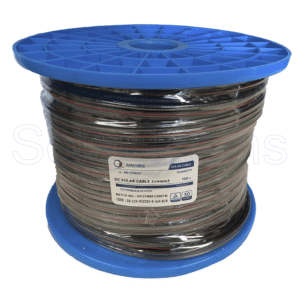
Solar Rains supplies 1500V 4mm² and 6mm² solar DC cable for professional PV installations.
View Solar Rains 4mm² and 6mm² Solar DC Cable
Frequently Asked Questions
Can 4mm² cable be used on a 6.6kW solar system?
Yes, depending on the system design.
The total system capacity does not determine cable size by itself. Installers still need to check current, cable length, voltage drop and installation conditions.
Is 6mm² cable always better than 4mm²?
No.
6mm² has lower resistance, but if 4mm² already meets all design requirements, the larger cable may offer only a small additional benefit.
Does a longer cable run need 6mm²?
Not automatically.
However, longer cables create more resistance and voltage drop. Therefore, the advantages of 6mm² become more significant as cable length increases.
What does “4mm solar cable” mean?
“4mm solar cable” commonly means a cable with a 4mm² conductor cross-sectional area.
Similarly, “6mm solar cable” usually refers to a 6mm² conductor.
Can standard electrical cable be used for solar panels?
The cable must be suitable for the PV system’s DC voltage, environmental exposure and installation conditions. Installers should check the exact cable’s technical documentation and applicable Australian requirements before use. AS/NZS 5033:2021 covers DC array wiring as part of PV-array installation requirements.
Final Verdict
The 4mm vs 6mm cable decision should come from proper electrical design rather than a simple system-size rule.
4mm² cable can work well for many shorter or moderate-current PV circuits. In contrast, 6mm² provides lower resistance and may offer a better solution for longer routes or more demanding operating conditions.
Before choosing, check the current, route length, voltage drop, installation environment and connector compatibility.