The top solar battery brands in Australia now offer more choice than ever, from simple all-in-one systems to highly expandable battery stacks. However, the best option for one household may not suit another because battery capacity, inverter compatibility, backup requirements and future expansion all affect the final choice.
In 2026, Australian buyers can compare established names such as AlphaESS, Deye, Sungrow and Tesla with newer or fast-growing storage systems from Swatten and SOFAR.
Solar Rains currently supplies selected AlphaESS, Deye, Swatten and SOFAR products. In addition, this guide includes Sungrow and Tesla to provide a broader comparison of the Australian residential battery market.
Top Solar Battery Brands: Quick Comparison
The top solar battery brands use different approaches to residential energy storage. Therefore, comparing only battery capacity does not provide the full picture.
| Brand | Best for | Main advantage | Main consideration |
|---|---|---|---|
| AlphaESS | Integrated residential systems | Battery and inverter ecosystem | Check exact model and expansion limits |
| Deye | Future expansion | Flexible modular batteries | Compatibility varies by configuration |
| Swatten | Easy installation | Lightweight stackable modules | Newer Australian market presence |
| SOFAR | All-in-one storage | Integrated modular system | Mainly built around SOFAR equipment |
| Sungrow | Sungrow inverter users | Mature product ecosystem | Use approved inverter combinations |
| Tesla | Backup and monitoring | Strong software experience | Larger capacity increments |
Most importantly, buyers should compare the complete system rather than choosing a battery based only on brand recognition.
How We Compare the Top Solar Battery Brands
When comparing the top solar battery brands, several factors matter more than a single headline specification.
Capacity and Power
Battery capacity shows how much energy the system can store. In contrast, power output tells you how much electricity the battery can deliver at one time.
For example, a home running large air conditioners, pumps or electric cooking equipment may require higher output even if its overnight energy consumption is moderate.
Backup Capability
If blackout protection matters, check the complete backup design.
In particular, homeowners should consider:
- Continuous backup power
- Surge capability
- Essential-load or whole-home backup
- Single-phase or three-phase requirements
- Backup-controller requirements
Therefore, a larger battery is not automatically better for backup if the inverter cannot provide enough power.
Compatibility and Expansion
Some battery systems work mainly with their own manufacturer’s inverter. Meanwhile, others offer wider compatibility.
Expansion also varies between products. Although a battery may be modular, adding capacity later can depend on firmware, module age, inverter limits and approved configurations.
Warranty and Support
Most leading brands advertise long warranty periods. However, buyers should also check energy-throughput limits, remaining-capacity conditions and installation requirements.
Local technical support can also make a major difference if the system develops a fault.
Top Solar Battery Brands for Australian Homes
Below are six top solar battery brands worth comparing in 2026.
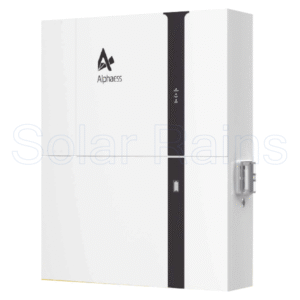
AlphaESS: Simple All-in-One Storage
AlphaESS is known for its SMILE residential storage systems, which combine battery storage, hybrid inverter functions and energy monitoring.
The current official SMILE5 information lists multiple battery options and supports DC-coupled, AC-coupled and hybrid configurations.
Because the major components work within one ecosystem, AlphaESS can simplify system design and monitoring.
Key advantages include:
- Integrated inverter and battery options
- Multiple battery capacities
- Residential backup applications
- Centralised monitoring
- Retrofit options within selected systems
However, specifications vary between individual SMILE models. Therefore, installers should confirm the exact inverter, battery module and supported expansion before ordering.
Solar Rains currently offers an AlphaESS inverter and battery all-in-one system for residential projects.
Best for: Homeowners who want a straightforward integrated energy-storage system.
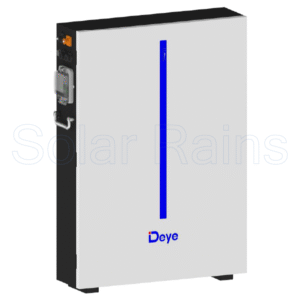
Deye: Flexible Modular Storage
Deye stands out among the top solar battery brands for its modular approach.
The official AI-W5.1-B specifications list a 5.12kWh LiFePO₄ battery module, with modular configurations available across supported systems.
As a result, installers can build different battery capacities around the customer’s energy requirements rather than starting with one fixed system size.
Key advantages include:
- 5.12kWh modular battery units
- LiFePO₄ chemistry
- Expandable architecture
- Residential and larger storage options
- Integration with compatible Deye inverters
On the other hand, Deye offers several inverter and battery families. Consequently, the exact approved combination should always be checked.
Best for: Projects where future battery expansion is an important consideration.
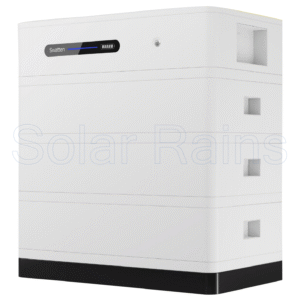
Swatten: Lightweight Stackable Battery
Swatten’s F1 Series focuses on modular installation.
According to Swatten’s current Australian information, the system supports three to eight modules per unit, providing total configurations from 9.6kWh to 25.6kWh. Each battery module weighs approximately 35kg, while the system carries an IP65 protection rating.
Therefore, installers may find the individual modules easier to handle where site access is limited.
Key advantages include:
- Lightweight modules
- Stackable design
- 9.6–25.6kWh configurations
- IP65 protection
- Expandable architecture
However, Swatten has a shorter history in the Australian residential market than several established competitors. For this reason, buyers should also consider local support and inverter compatibility.
Best for: Installers looking for a lightweight and flexible stackable system.
SOFAR PowerAll: Integrated Modular ESS
SOFAR PowerAll combines a hybrid inverter and high-voltage battery modules within one residential energy-storage platform.
The current PowerAll single-phase range lists 5kWh to 30kWh battery configurations. In addition, SOFAR states that the system supports expandable capacity and compatible combinations of new and existing batteries.
This integrated design can reduce the complexity of matching separate inverter and battery brands.
Key advantages include:
- 5–30kWh configurations
- Integrated system design
- Expandable storage
- Backup operation in supported installations
- Simplified component matching
Nevertheless, PowerAll mainly operates within the SOFAR ecosystem. Therefore, owners of existing solar systems should first check whether retaining their current inverter makes sense.
Best for: Homes wanting an integrated and expandable battery system.
Sungrow: Established Battery Ecosystem
Sungrow remains an important comparison point when evaluating the top solar battery brands, particularly for customers already considering a Sungrow hybrid inverter.
The brand offers modular high-voltage residential storage systems that integrate with selected Sungrow inverters.
One major advantage is that homeowners can keep the inverter, battery and monitoring environment within the same manufacturer ecosystem.
Key advantages include:
- Established Australian solar presence
- Modular battery options
- Hybrid inverter integration
- LFP battery technology in current residential ranges
- Single-phase and three-phase system options
However, compatibility differs between Sungrow battery families and inverter models. As a result, installers should confirm the exact approved system rather than choosing by brand alone.
Independent Australian market data also shows Sungrow remains a major battery and energy-storage manufacturer in 2026.
Best for: Customers already using or planning a Sungrow hybrid inverter.
Tesla Powerwall 3: Backup and Software
Tesla Powerwall 3 is the current Tesla residential battery platform in Australia.
According to Tesla Australia, Powerwall 3 provides 13.5kWh of energy capacity and up to 10kW of on-grid and backup power, depending on local conditions. The system also includes an integrated solar inverter.
In addition, Tesla’s app allows owners to monitor solar generation, battery use and household energy flow.
Key advantages include:
- 13.5kWh battery capacity
- Strong backup capability
- Integrated solar inverter
- Tesla app monitoring
- Supported expansion options
However, Tesla uses larger capacity increments than many modular systems. Consequently, homeowners who want very precise battery sizing may prefer smaller modular batteries.
Best for: Homes prioritising backup capability and a polished monitoring experience.
Which Top Solar Battery Brands Suit Different Needs?
The top solar battery brands are easier to compare when you start with the customer’s actual goal.
Best for a Simple Integrated System
Consider:
- AlphaESS
- SOFAR PowerAll
- Tesla Powerwall 3
These products keep more major system components within one ecosystem.
Best for Future Expansion
Deye and Swatten are particularly useful when flexible capacity is important.
Meanwhile, other modular systems can also support expansion, although installers should confirm the manufacturer’s conditions before the original installation.
Best for Existing Sungrow Systems
A compatible Sungrow battery may provide the simplest integration when the home already uses an appropriate Sungrow hybrid inverter.
Best for Backup Power
Tesla Powerwall 3 is a strong option to compare. However, appropriately designed systems from AlphaESS, Deye, SOFAR and Sungrow can also provide backup.
Therefore, compare inverter output and backup design rather than battery capacity alone.
Battery Rebates and CEC Approval
When comparing the top solar battery brands, current Australian rebate rules also matter.
Australia’s Cheaper Home Batteries Program supports eligible battery systems. According to the Department of Climate Change, Energy, the Environment and Water, eligible systems generally need 5kWh to 100kWh of nominal capacity, subject to the program’s other conditions. The eligibility guidance was updated on 1 May 2026.
In addition, the Clean Energy Council maintains the Approved Batteries List. The CEC states that government rebate programs and electricity networks may require products from this list.
Therefore, buyers should not assume that every product from a well-known manufacturer automatically qualifies.
Before ordering, check:
- The exact battery model
- The inverter or PCE combination
- The complete battery configuration
- Current CEC listing status
- Current program eligibility
The CEC is also transitioning its battery-listing requirements toward SA TS 5398, with changes already applying to new approvals from 2026.
FAQs About Top Solar Battery Brands
What are the top solar battery brands in Australia?
Some of the top solar battery brands worth comparing include AlphaESS, Deye, Swatten, SOFAR, Sungrow and Tesla.
However, the right brand depends on the customer’s inverter, energy usage, backup needs and budget.
Which battery brands does Solar Rains supply?
Solar Rains currently offers selected residential battery products from AlphaESS, Deye, Swatten and SOFAR.
Is a 10kWh battery enough for a home?
It depends on the household’s consumption after solar production falls in the evening.
For example, a home using relatively little electricity overnight may not benefit from a very large battery. In contrast, electric heating, air conditioning or EV charging can increase storage requirements.
Is a larger solar battery always better?
No. An oversized battery costs more and may leave a large amount of storage unused. Therefore, battery size should reflect actual consumption, solar generation and backup requirements.
Do all battery brands qualify for the federal battery program?
No. Eligibility depends on the exact battery system and its current approval status rather than the manufacturer’s name alone. Buyers should check the latest government requirements and CEC list before installation.
Final Verdict
The top solar battery brands in Australia serve different types of projects.
AlphaESS and SOFAR are useful options for integrated residential systems. Meanwhile, Deye and Swatten offer flexible modular storage. Sungrow makes sense for many customers already using its inverter ecosystem, while Tesla Powerwall 3 remains a strong option for backup and software.
Instead of choosing the battery with the biggest specification number, compare the complete system:
- Usable capacity
- Power output
- Backup capability
- Inverter compatibility
- Expansion
- Warranty
- Local support
- CEC approval
- Rebate eligibility
Ultimately, the best option is the battery that matches the home’s actual energy requirements and the rest of the solar system.
Solar Rains supplies selected residential battery and inverter systems from AlphaESS, Deye, Swatten and SOFAR for Australian residential and installer projects.