
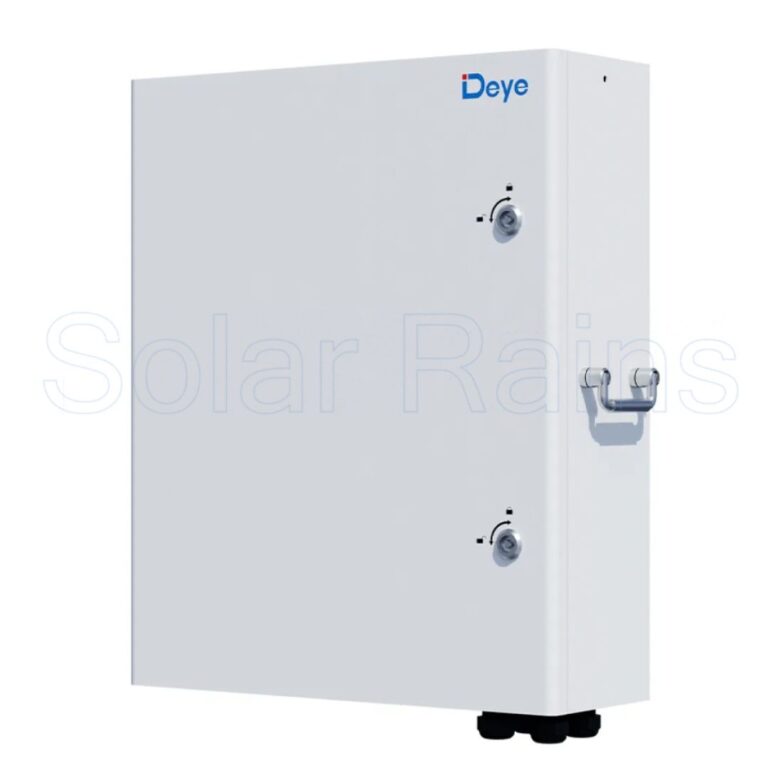
Energy Managment System (EMS) Controller for Deye High Voltage C&I Battery Cabinet 215kWh
$5,280.00
Add the product to your cart and request a quote at checkout
Description
The DEYE High Voltage C&I Battery Cabinet 215kWh (EMS), listed under SKU MS-EMS 1000, is associated with Deye’s MS-EMS energy management system for energy storage applications. Deye identifies the MS-EMS as an energy management controller specifically configured for Energy Storage Systems (ESS), serving as a core control unit for energy storage power plants and commercial and industrial energy storage projects.
The controller is designed for overall operation monitoring, energy dispatch, safety protection and data analysis. It supports a single-point access capacity of up to 3.44MWh for energy storage and up to 1.6MWp for photovoltaic systems. Its functions include peak-valley arbitrage, anti-backflow, main transformer overload protection, load tracking, demand control, backup power, phase separation control, SOC balancing and Deye Cloud monitoring.
Key Features of Product
Energy Management & Control
The MS-EMS is designed to coordinate key energy management functions within an ESS. Its basic functions include peak-valley arbitrage, anti-backflow, main transformer overload protection, load tracking, demand control, backup power, phase separation control and SOC balancing.
Advanced functions include load forecasting, production planning, electricity price planning and an optimal economic curve. These functions are intended to support more structured energy dispatch and management across compatible energy storage applications.
Large Single-Point Access Capacity
The MS-EMS supports a single-point access capacity of up to 3.44MWh for energy storage and up to 1.6MWp for photovoltaic systems. This makes it suitable for the management architecture of larger commercial and industrial energy storage projects.
Extensive Communication Interfaces
The controller provides a broad selection of communication interfaces for system integration. It includes five Ethernet channels supporting 10/100/1000 Mbps, two 1Gbps optical ports, two USB host ports, three isolated CAN channels with two supporting CAN-FD, eight isolated RS485 channels and three RS232 channels.
It also includes a TF card slot, an LVDS interface with a DVI physical interface and USB for touch, one M.2 interface with PCIe2.0 X1 and scalable SSD support, 17 optocoupler-isolated digital inputs and eight relay-isolated digital outputs.
Wireless communication is supported through WLAN with 802.11 b/g/n/ac, HT20/40 and 2.4GHz/5GHz operation.
Local & Cloud Operation and Maintenance
The MS-EMS manual identifies local and cloud operation and maintenance as part of its efficient O&M features. It supports WEB and APP-based operation and maintenance methods, while Deye Cloud monitoring is included among its basic functions.
The system also provides real-time equipment malfunction alarms and SOC balance management, helping operators monitor the operating status of the energy storage system.
Compact Wall-Mounted Design
The MS-EMS configuration includes an EMS controller, lightning protection module, switch power supply, UPS module and switch. The internal structure also identifies the EM-1000 energy management module, AC/DC power module, DC24V backup power module, surge protection device and UPS backup lead-acid battery.
The controller has a metal enclosure measuring 488 × 188 × 588mm and weighs approximately 24.5kg or less. It is specified for indoor or outdoor, wall-mounted installation. The enclosure has an IP54 protection rating and an anti-corrosion grade of ≥C4.
The operating temperature range is -15°C to +50°C, with storage temperature also specified at -15°C to +50°C. Working humidity is 5%–95%, and maximum working altitude is 3,000m.
Main Benefits
For Commercial & Industrial Energy Storage Projects
The MS-EMS is specifically configured for ESS and is described as the core control unit for energy storage power plants and commercial and industrial energy storage projects. It brings monitoring, energy dispatch, safety protection and data analysis into the system’s control architecture.
For Energy Management
The combination of peak-valley arbitrage, load tracking, demand control, anti-backflow and main transformer overload protection provides a range of documented control functions for managing energy flows and operating conditions.
For Remote Monitoring & O&M
Deye Cloud monitoring, together with local and cloud operation and maintenance through WEB and APP methods, provides operators with different ways to access system information and manage equipment. Deye ESS
For Larger ESS Configurations
With single-point access capacity of up to 3.44MWh for energy storage and 1.6MWp for PV, the MS-EMS is designed for larger-scale energy management requirements rather than small standalone applications.
Installation
Installation should only be carried out by qualified professionals or trained personnel following the Deye manual, relevant electrical requirements and applicable local standards. The manual states that the equipment must be completely de-energised for electrical connections and that appropriate PPE and insulated tools must be used.
1. Prepare the Installation Location
Select a clean, dry and well-ventilated location that meets the specified environmental conditions. The controller must not be installed in low-lying areas where it could be submerged, near water leakage or condensation sources, or where ventilation and heat dissipation could be obstructed.
Deye specifies minimum clearances of 200mm for the listed A and B distances and 300mm for C. The installation area should also provide sufficient space for expansion and maintenance requirements.
2. Check the Mounting Method
The MS-EMS can be installed indoors or outdoors as a wall-mounted unit. Deye also recommends installation on its AC collection cabinet, such as the MS-TS500-2-A, when that cabinet is purchased.
For wall mounting, mark the mounting positions, drill holes to a depth of 100–110mm, secure the mounting plate with four M6×100 expansion bolts, attach the rear wall-mounting bracket using eight M6×10 expansion bolts and then attach the MS-EMS to the mounting plate.
3. Prepare Electrical Connections
All electrical connections must be performed with the equipment completely de-energised. The manual requires qualified electrical professionals to carry out the electrical connection and states that the equipment must be used with overvoltage protection.
Before connection, confirm that there is no voltage on the AC and DC sides, check cable polarity and follow the installation diagram and terminal polarity. The manual lists cable requirements including CAT.5E, 12 AWG, 16 AWG and 2 × 0.5mm² twisted-pair shielded wire, depending on the connection.
4. Complete Communication & Control Connections
The MS-EMS supports multiple communication and signal interfaces. The manual also describes optional DRM dry-contact connections through the EM-1000 module and ring network communication cable connections.
When the MS-EMS is used with the MS-TS500-2-A AC collection cabinet, Deye provides specific connection guidance in the manual. If the cabinet is not purchased, the corresponding electrical connection is optional and can be skipped.
5. Complete Grounding
The protective earth cable must be securely connected. After grounding, the grounding resistance must be measured according to applicable national and local requirements. The manual specifies a recommended torque of 25N·m for the protective earth terminal connection.
After all connections are completed, carefully verify that every connection is correct and secure before operation.
Deye
Ningbo Deye Inverter Technology Co., Ltd. was founded in 2007 and is a subsidiary of the Deye Group. Deye describes itself as a technology-oriented company specialising in integrated solar PV and energy storage solutions for residential, commercial and industrial applications.
Its product portfolio includes PV inverters, hybrid inverters and microinverters, while its energy solutions include commercial energy storage systems and battery product lines designed for Deye inverters. Deye also identifies 100/125kW–2.5MW C&I ESS solutions within its energy product portfolio.
For more information about Deye and its product portfolio, visit Deye Australia.
The MS-EMS is an energy management controller specifically configured for Energy Storage Systems. Deye describes it as a core control unit for energy storage power plants and commercial and industrial energy storage projects, responsible for overall operation monitoring, energy dispatch, safety protection and data analysis.
The documented single-point access capacity is up to 3.44MWh for energy storage and up to 1.6MWp for photovoltaic systems. These figures describe the system access capacity of the controller rather than the energy capacity of the controller itself.
The MS-EMS supports peak-valley arbitrage, anti-backflow, main transformer overload protection, load tracking, demand control, backup power, phase separation control, SOC balancing and Deye Cloud monitoring. Advanced functions include load forecasting, production planning, electricity price planning and an optimal economic curve.
Yes. Deye lists Deye Cloud monitoring as a basic function, while the manual describes local and cloud operation and maintenance through WEB and APP methods. The controller also provides Ethernet and WLAN communication capabilities.
The MS-EMS is specified for indoor or outdoor, wall-mounted installation. Deye also recommends mounting it on the MS-TS500-2-A AC collection cabinet when that cabinet is purchased. The wall-mounting procedure uses a mounting plate, four M6×100 expansion bolts and eight M6×10 bolts for the rear mounting bracket.
Deye states that only qualified professionals or trained personnel are permitted to install and operate the equipment. Electrical connections must be performed by qualified electrical professionals, with the equipment completely de-energised and appropriate PPE and insulated tools used.
| Dimensions and Weights | |
|---|---|
| Weight | 24.5 kg |
| Dimensions | 18.8 x 48.8 x 58.8 cm |
| Specification | MS-EMS |
|---|---|
| System | |
| Configuration | EMS controller, lightning protection module, switch power supply, UPS module, switch |
| Single Point Access Capacity | Energy storage≤3.44MWh, Photovoltaic≤1.6MWp |

| Specification | MS-EMS |
|---|---|
| System | |
| Configuration | EMS controller, lightning protection module, switch power supply, UPS module, switch |
| Single Point Access Capacity | Energy storage≤3.44MWh, Photovoltaic≤1.6MWp |
| Function | Basic functions: peak valley arbitrage, anti-backflow, main transformer overload protection, load tracking, demand control, backup power function, phase separation control, SOC balancing, Deye Cloud monitoring. Advanced features: load forecasting, production planning, electricity price planning, optimal economic curve |
| Communication Interface | |
| Ethernet (5 channels) | 10/100/1000 Mbps |
| Optical Port (2 channels) | 1Gbps |
| USB (2 channels) | Host |
| CAN (3 channels) | Isolation, with 2 channels supporting CAN-FD |
| RS485 (8 channels) | Isolation |
| RS232 (3 channels) | 2 isolated channels, 1 non-isolated debugging channel (DB9 socket) |
| TF Card (1 channel) | Standard TF card holder |
| LVDS (1 channel) | The physical interface is DVI (including 1 USB for touch) |
| M.2 Interfaces (1 channel) | PCIe2.0 X1, Scalable SSD (standard 1TB) |
| DI (17 channels) | Optocoupler isolation |
| DO (8 channels) | Relay isolation |
| WLAN | 802.11 b/g/n/ac, HT20/40, 2.4 GHz & 5 GHz |
| Power Supply | |
| Communication Input | 220Vac |
| DC IN | 24Vdc |
| UPS Backup Power | 24Vdc |
| Consumption | Max 25W |
| Environmental Parameters | |
| Operation Temperature | -15°C~50°C |
| Storage Temperature | -15°C~50°C |
| Working Humidity | 5%~95% |
| Max. Working Altitude (m) | ≤3000m |
| IP Rating of Enclosure | IP54 |
| Anti-Corrosion Grade | ≥C4 |
| Mechanical Parameters | |
| Dimension (W×D×H, mm) | 488×188×588 |
| Weight Appr. (kg) | ≤24.5kg |
| Installation Location | Indoor or outdoor, wall-mounted |
| Box Material | Metal |
| Incoming Specifications | AC power cord: Recommended wire diameter 1.5mm²; DC power cord: Recommended wire diameter of 1.5mm²; 8-core Ethernet cable: Recommended CAT5e Ethernet cable; RS485: Recommended 0.75mm²~1.5mm² outdoor UV protection with shielding layer twisted pair cable length≤1000m (baud rate 9600) |


Reviews
There are no reviews yet.