
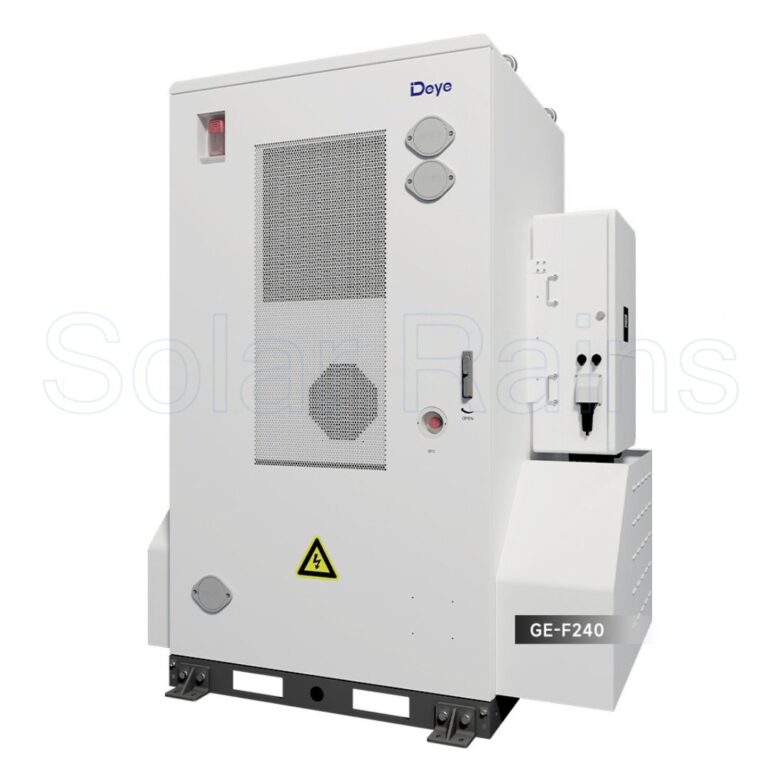
Deye High Voltage C&I Battery Cabinet 128kWh, 240kWh & 256kWh w/o Inverter
Price range: $44,000.00 through $77,000.00
Add the product to your cart and request a quote at checkout
Description
The DEYE High Voltage C&I battery cabinet range is designed for commercial and industrial energy storage applications and includes three configurations: GE-F128-BC-2-A3, GE-F240-BC-2-A3 and GE-F256-BC-2-A3. The cabinets use LiFePO4 battery cells and are built around 16.08kWh battery modules rated at 51.2V and 314Ah.
The Deye 128kWh battery cabinet uses eight battery modules in series, providing 128.61kWh of system nominal energy, a 409.6V nominal system voltage and 64kW rated DC power. The GE-F240-BC-2-A3 uses 15 modules for 241.15kWh nominal energy, 768V nominal voltage and 121kW rated DC power. The GE-F256-BC-2-A3 uses 16 modules, providing 257.23kWh nominal energy, 819.2V nominal voltage and 129kW rated DC power.
These are battery cabinet configurations rather than complete inverter systems. Deye’s documentation specifies compatible hybrid inverter and PCS configurations separately, allowing the battery cabinet to form part of a larger C&I energy storage system. The Deye product page lists the GE-F128, GE-F240 and GE-F256 models specifically for EU, AS, AF, LATAM and AU markets.
Key Features of Product
- LiFePO4 battery chemistry with 314Ah module capacity and 51.2V nominal module voltage.
- 16.08kWh energy per battery module.
- GE-F128-BC-2-A3: 8 modules, 128.61kWh nominal energy, 409.6V nominal voltage and 64kW rated DC power.
- GE-F240-BC-2-A3: 15 modules, 241.15kWh nominal energy, 768V nominal voltage and 121kW rated DC power.
- GE-F256-BC-2-A3: 16 modules, 257.23kWh nominal energy, 819.2V nominal voltage and 129kW rated DC power.
- Recommended charge/discharge current of 157A, maximum continuous current of 180A and peak discharge current of 285A under the specified conditions.
- Smart air cooling.
- Operating temperature range of -30°C to 55°C.
- Recommended storage temperature of 0°C to 35°C.
- IP55 protection.
- CAN and RS485 communication ports with CAN2.0 and Modbus485 communication protocols.
- Floor-mounted installation.
- At least 8,000-cycle life under Deye’s stated test conditions.
- 10-year warranty.
- Certifications listed in the Australian brochures include UN38.3, CE, IEC62619, IEC62477, IEC62933-5-2, UL9540A and CEC.
The cabinet’s safety design includes electrical isolation, fire detection, active exhaust, explosion venting, fire suppression and thermal isolation. Deye also specifies a high-intensity cabinet structure and a patented door-latch design within the ORION E product information.
The Australian brochures also specify DC-side parallel expansion of up to 10 battery cabinets. The documented expansion capacity is up to 1.28MWh for the GE-F128 series, 2.4MWh for the GE-F240 series and 2.57MWh for the GE-F256 series.
Main Benefits
For commercial and industrial facilities, the Deye high voltage C&I battery cabinet range provides three different storage configurations that can be selected according to the required system capacity and operating voltage.
The common 16.08kWh LiFePO4 battery module provides a consistent battery architecture across the range, while the number of modules connected in series determines the individual cabinet’s energy and voltage configuration. This gives system designers clear options between the GE-F128, GE-F240 and GE-F256 configurations.
For projects requiring future capacity expansion, the documented ability to connect up to 10 battery cabinets in parallel on the DC side provides a defined expansion path. Depending on the selected series, the brochures specify maximum configurations of 1.28MWh, 2.4MWh or 2.57MWh.
The Deye 240kWh battery cabinet and Deye 256kWh battery cabinet also provide higher system voltage configurations than the GE-F128, making the three models suitable for different system designs while retaining the same LiFePO4 battery module technology.
The cabinet design combines smart air cooling, IP55 protection, communication interfaces and multiple safety functions. These specifications provide a defined equipment platform for integration with compatible Deye power conversion equipment in C&I energy storage applications.
Installation
Installation must be carried out by qualified professionals or trained personnel who understand the required safety precautions and applicable local standards. The manual states that unauthorised changes to assembly procedures and technical parameters are not permitted.
Before installation, confirm that the site has sufficient load-bearing capacity and provide a clean, dry and well-ventilated installation area. The equipment should be protected from flammable or explosive gases, smoke, heat sources, liquids, condensation, strong vibration and excessive electromagnetic interference. The installation surface must be flat, level, waterproof and capable of supporting the system.
The manual specifies that each battery pack requires ventilation of 112.6m³/h. Total ventilation demand must therefore be considered according to the number of battery packs installed. When the battery system is paired with a PCS, a minimum clearance of 300mm should be maintained between the battery system and PCS. The manual also states that the battery system may be placed against a wall, with no obstacles within 1m in front of the battery system.
For assembly, place the four bases on a level and solid surface and adjust the levelling feet. Battery packs are then installed one by one in a stacked arrangement and secured using the specified M5 bolts. The maximum allowable stacking height for a single battery-pack stack is four layers.
The PDU is installed on the top battery pack of the first stack. Additional battery stacks are positioned according to the approved installation layout before the communication cables, power cables and copper-bar connections are completed. The manual specifically cautions installers to pay attention to cable direction during this stage.
Each battery stack must be grounded. For systems using the 100kW or 125kW Deye Power Conversion Unit, the manual specifies the applicable power-cable configuration and requires the communication cable between the Power Conversion Unit and PDU to be no longer than 30m.
After installation, inspect the system and battery packs for damage, confirm that the bases, brackets and bolts are secure, ensure grounding markings are clear, check that air outlets are unobstructed and verify that fire-fighting equipment and warning signs are in place. The installation passage must also remain unobstructed and free from flammable or explosive materials.
Deye
Deye is a Chinese high-tech enterprise and a subsidiary of the Deye Group. Ningbo Deye Inverter Technology Co., Ltd. was founded in 2007 and has a manufacturing plant covering more than 15,000m² with production and testing facilities.
According to Deye Australia, the company specialises in integrated solar PV and energy storage solutions for residential, commercial and industrial applications. Its product portfolio includes PV inverters, hybrid inverters, microinverters and energy storage products. Deye also identifies 100/125kW–2.5MW C&I ESS solutions among its energy solutions.
Deye states that it has developed battery product lines tailored to Deye inverters and high-efficiency outdoor energy storage systems for commercial and industrial buildings of different scales.
The primary difference is the number of battery modules and the resulting system energy and voltage. GE-F128-BC-2-A3 uses eight modules and has 128.61kWh nominal energy at 409.6V. GE-F240-BC-2-A3 uses 15 modules and has 241.15kWh at 768V. GE-F256-BC-2-A3 uses 16 modules and has 257.23kWh at 819.2V.
The three products in this range are battery cabinet configurations without an inverter. Deye’s documentation lists compatible hybrid inverter and PCS configurations separately, so the cabinet forms the battery-storage component of the wider energy storage system.
All three models use LiFePO4 battery cells. Each battery module has a nominal capacity of 314Ah, nominal voltage of 51.2V and energy of 16.08kWh. The specified cycle life is at least 8,000 cycles under the stated test conditions.
Yes. The Australian brochures specify up to 10-unit parallel expansion on the DC side. The documented maximum capacity is up to 1.28MWh for the GE-F128 series, 2.4MWh for the GE-F240 series and 2.57MWh for the GE-F256 series.
The products are presented by Deye as outdoor battery cabinets and have an IP55 protection rating. The specified operating temperature is -30°C to 55°C, with a recommended storage temperature of 0°C to 35°C. The installation manual also permits indoor installation provided the stated environmental, ventilation, safety and access requirements are met.
The installation site must have adequate load-bearing capacity, suitable ventilation, appropriate clearances and protection from fire, liquids, condensation and other prohibited environmental conditions. Installation and electrical work must be performed by qualified personnel. The manual also requires each battery stack to be grounded and specifies the required communication and power connections for compatible power conversion units.
| Dimensions and Weights | |
|---|---|
| SKU | GE-F128-BC-A3 |
| Weight | 1690 kg |
| Dimensions | 124 x 99.8 x 240.55 cm |
| Dimensions and Weights | |
|---|---|
| SKU | GE-F240-BC-A3 |
| Weight | 2610 kg |
| Dimensions | 124 x 130.3 x 240.55 cm |
| Dimensions and Weights | |
|---|---|
| SKU | GE-F256-BC-A3 |
| Weight | 2770 kg |
| Dimensions | 124 x 130.3 x 251 cm |
| Download Area | |
|---|---|
DEYE High Voltage C&I Battery Cabinet 128kWh w/o inverter - Datasheet | Download |
DEYE High Voltage C&I Battery Cabinet 240kWh w/o inverter - Datasheet | Download |
DEYE High Voltage C&I Battery Cabinet 256kWh w/o inverter | Download |
Deye NSW Peak Demand Reduction Scheme PDRS Solutions | Download |
| Model | GE-F128-BC-2-A3 |
|---|---|
| Main Parameters | |
| Cell Type | LiFePO₄ |
| Module Capacity (Ah) | 314 |
| Module Nominal Voltage (Vdc) | 51.2 |
| Module Energy (kWh) | 16.08 |
| Module Qty In Series | 8 |
| System Nominal Energy (kWh) | 128.61 |
| System Usable Energy (kWh)*1 | 128.61 |
| System Nominal Voltage (Vdc) | 409.6 |
| System Operating Voltage (Vdc) | 320-467.2 |
| Rated DC Power (kW) | 64 |
| Charge/Discharge Max. Continuous Current(A)*2 | |
| Peak discharge@15s/25±2℃ | |
| Other Parameters | |
| Fire Protection System | Aerosol and Water fire interface CO gas detection, Active exhaust and Explosion venting |
| Cooling Method | Smart Air Cooling |
| Communication Port | CAN, RS485 |
| Communication protocol | CAN2.0, Modbus485 |
| Operating Temperature(℃)*3 | -30-55 |
| Recommend Storage Temperature(℃) | 0-35 |
| Humidity | 5% – 95%RH (No Condensing) |
| Altitude | 3000m |
| IP Protection | |
| Anti Corrosion Level | C4-M |
| Dimension(W x D x H mm) | 998 x 1240 x 2405.5 |
| Weight(kg) | 1690 |
| Installation Location | Floor mount |
| Cycle Life | ≥8000 (25±2℃ 0.5P EOL70%) |
| Warranty | 10 years |
| Certification | UN38.3,CE,IEC62619,IE62477,IEC62933-5-2,UL9540A |
| Model | GE-F128-BC-2-A3 |
|---|---|
| Main Parameters | |
| Cell Type | LiFePO₄ |
| Module Capacity (Ah) | 314 |
| Model | GE-F240-BC-2-A3 |
|---|---|
| Main Parameters | |
| Cell Type | LiFePO₄ |
| Module Capacity (Ah) | 314 |
| Module Nominal Voltage (Vdc) | 51.2 |
| Module Energy (kWh) | 16.08 |
| Module Qty In Series | 15 |
| System Nominal Energy (kWh) | 241.15 |
| System Usable Energy (kWh)*1 | 241.15 |
| System Nominal Voltage (Vdc) | 768 |
| System Operating Voltage (Vdc) | 600-876 |
| Rated DC Power (kW) | 121 |
| Charge/Discharge Max. Continuous Current(A)*2 | 180 |
| Peak discharge@15s/25±2℃ | 285 |
| Other Parameters | |
| Fire Protection System | Aerosol and Water fire interface CO gas detection, Active exhaust and Explosion venting |
| Cooling Method | Smart Air Cooling |
| Communication Port | CAN, RS485 |
| Communication protocol | CAN2.0, Modbus485 |
| Operating Temperature(℃)*3 | -30-55 |
| Recommend Storage Temperature(℃) | 0-35 |
| Humidity | 5% – 95%RH (No Condensing) |
| Altitude | 3000m |
| IP Protection | IP55 |
| Anti Corrosion Level | Standard: C4-M, customizable up to C5 |
| Dimension(W x D x H mm) | 1303 x 1240 x 2405.5 |
| Weight(kg) | 2610 |
| Installation Location | Floor mount |
| Cycle Life | ≥8000 (25±2℃ 0.5P EOL70%) |
| Warranty | 10 years |
| Certification | UN38.3,CE,IEC62619,IE62477,IEC62933-5-2,UL9540A |
| Model | GE-F240-BC-2-A3 |
|---|---|
| Main Parameters | |
| Cell Type | LiFePO₄ |
| Module Capacity (Ah) | 314 |
| Model | GE-F256-BC-2-A3 | |
|---|---|---|
| Cell Type | LiFePO₄ | |
| Module Capcity (Ah) | 314 | |
| Module Nominal Voltage (Vdc) | 51.2 | |
| Module Energy(kWh) | 16.08 | |
| Module Qty In Series | 16 | |
| System Nominal Energy(kWh) | 257.23 | |
| System Usable Energy (kWh) | 257.23 | |
| System Nominal Voltage (Vdc) | 8192 | |
| System Operating Voltage(Vdc) | 640~934.4 | |
| Rated DC Power (kW) | 129 | |
| Charge/Discharge Current(A) | Recommend | 157 |
| Max.Continuous | 180 | |
| Peak discharge @15s/20~45℃ | 285 | |
| Other Parameters | ||
| Fire Protection System | Aerosol and Water fire interface,CO gas detection,Active exhaust and Explosion venting | |
| Cooling Method | SmartAir Cooling | |
| Communication Port | CAN,RS485 | |
| Communication protocol | CAN2.0,Modbus485 | |
| Operating Temperaturel (℃) | -30~55 | |
| Recommend Storage Temperaturel(℃) | 0-35 | |
| Humidity | 5%~95%RH (No Condensing) | |
| Altitude | 3000m | |
| IP Protection | IP55 | |
| Anti Corrosion Level | Standard:C4-M,customizable up to C5 | |
| Dimension(WxDxH,mm) | 1303×1240×2510 | |
| Weight(kg) | 2770 | |
| Installation Location | Floor mount | |
| Cycle Life | ≥8000(25±2℃,0.5P,EOL70%) | |
| Warranty | 10 years | |
| Certification | UN38.3,CEJEC62619,E62477,IEC62933-5-2,UL9540A | |
| Model | GE-F256-BC-2-A3 | |
|---|---|---|
| Cell Type | LiFePO₄ | |
| Module Capcity (Ah) | 314 | |
| Module Nominal Voltage (Vdc) | 51.2 | |


Reviews
There are no reviews yet.