
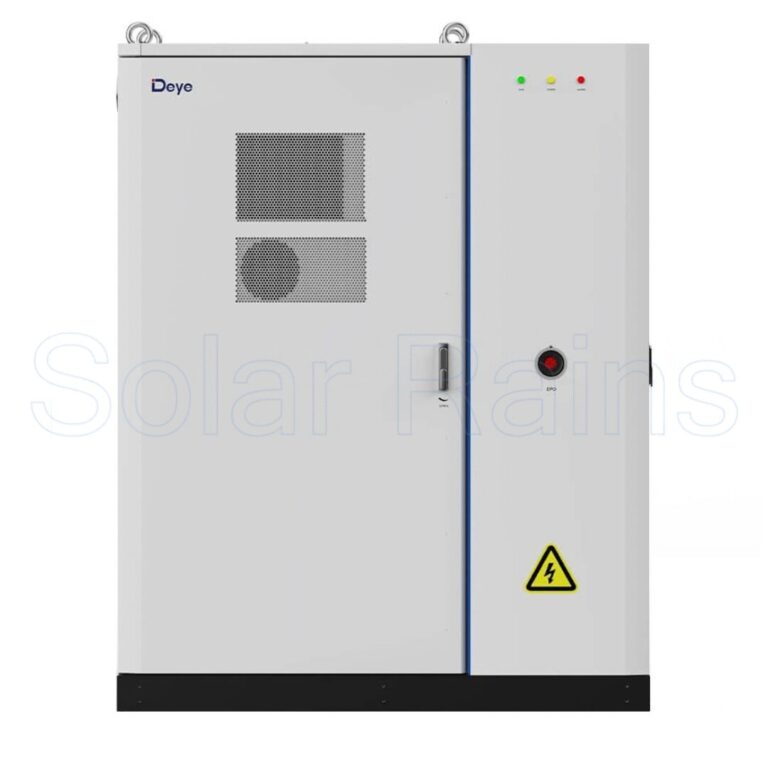
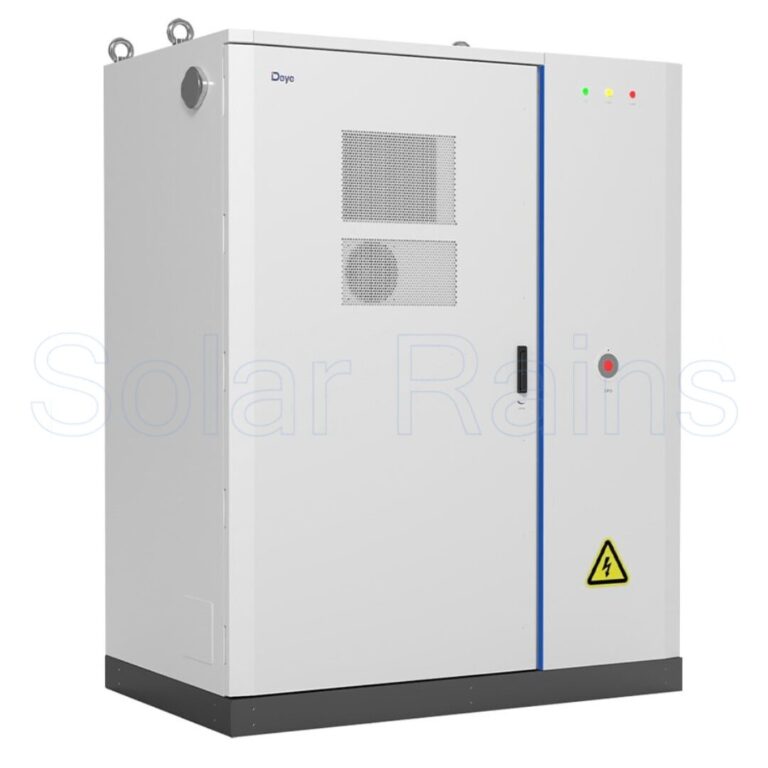
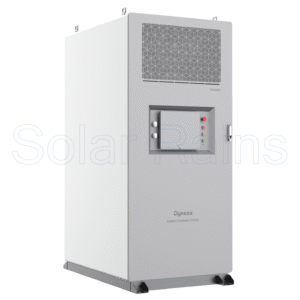
Deye High Voltage C&I Battery Cabinet 120kWh (BOS Pro) w/o Base Cabinet
$53,338.00
Add the product to your cart and request a quote at checkout
Description
The DEYE GE-F120-2H6 is an integrated small-scale commercial & industrial C&I energy storage system designed for high-rate cyclic charging and discharging applications. The system combines a power conversion system, inverter, battery management system and energy management system in an all-in-one architecture.
For the Australian model, the documented energy configuration is 122.8kWh, with 100kWh of usable energy. The DEYE GE-F120-2H6 provides 50kW nominal output / UPS power, an AC output rated current of 72.5A and a battery operating voltage of 500–700V. It uses LiFePO4 battery chemistry and is floor-mounted in an IP55 enclosure.
The battery system is designed with local management functions for monitoring voltage, current, temperature, humidity and smoke. Its battery management system also balances battery capacity. The system supports black start, off-grid operation and parallel expansion, making it suitable for the small-scale commercial & industrial applications identified by Deye, including farms, malls or shops and factories.
Key Features of Product
122.8kWh Energy Configuration
The DEYE GE-F120-2H6 has an energy configuration of 122.8kWh and 100kWh system usable energy. The system uses battery modules rated at 51.2V and 5.12kWh each, with CAN communication for the battery management system.
50kW Nominal Output
For the DEYE GE-F120-2H6, the nominal output / UPS power is 50kW, with an AC output rated current of 72.5A. The battery operating voltage is 500–700V. The system has a maximum RTE of 89%.
Integrated System Architecture
The DEYE GE-F120-2H6 battery system integrates PCS, inverter, battery BMS and EMS. The local management system monitors key operating parameters. This architecture brings the main energy storage and power conversion functions into a single cabinet.
LiFePO4 Battery Chemistry
The system uses LiFePO4 battery chemistry. The GE-F120-2H6 battery modules have a specified cycle life of at least 6,000 cycles under the stated test conditions of 25°C ±2°C, 0.5C charge/discharge and 70% EOL.
Multi-Layer Protection
The supplied brochure identifies combustible gas, smoke and temperature detection, active exhaust and fire alarm functions. The battery system also uses an aerosol fire suppression solution. An explosion relief plate and combustible-gas exhaust arrangement are described in the user manual.
Cooling & Environmental Protection
The cabinet has an integrated air-cooled air-conditioning system designed to maintain the BESS at a constant temperature. The enclosure is rated IP55. The specified storage temperature is 0–35°C, while the operating temperature is -20–55°C, with derating above 43°C.
Monitoring & Communication
The system supports CAN, RS485, RS232 and Wi-Fi communication according to the supplied product information. Deye also provides Deye Cloud for data acquisition, monitoring and operation and maintenance functions.
Parallel Expansion
The GE-F120-2H6 supports up to 10 units in parallel in off-grid operation according to the product documentation. The brochure also presents expansion configurations using multiple GE-F120 units for larger energy storage requirements.
Main Benefits
For Farms, Shops & Factories
Deye identifies this high voltage C&I battery system within its small-scale commercial and industrial applications, including farms, malls or shops and factories. The GE-F120-2H6 combines 50kW nominal output with 100kWh usable energy in one integrated system.
For Off-Grid Applications
The system supports black start and off-grid operation. Its documented parallel capability also allows multiple units to be configured when greater capacity or longer power support duration is required.
For System Monitoring
The local management system monitors voltage, current, temperature, humidity and smoke, while the BMS balances battery capacity. Communication interfaces and Deye Cloud provide options for system data acquisition and monitoring.
For Long-Term Operation
The battery specification states a cycle life of at least 6,000 cycles under the stated test conditions, while the system warranty is 10 years. The brochure also states 70% EOL under the specified cycle-life conditions.
Installation
Installation of the GE-F120-2H6 must be performed by professional electrical technicians and in accordance with the relevant local requirements. The following is a simplified overview of the manufacturer’s installation procedure.
1. Check the Equipment Before Installation
Check the cabinet and internal equipment against the packing list and inspect for damage. Confirm that the installation area is ready before moving the equipment.
2. Prepare the Installation Environment
The system can be installed indoors or outdoors. The installation area should be dry and well ventilated, away from toxic or harmful gases and flammable, explosive or corrosive materials.
For outdoor installation, the foundation must provide sufficient mechanical support and drainage. Deye recommends a foundation height of at least 300mm and requires the foundation to be level, secure, flat and able to support the equipment weight.
For indoor installation, the manual specifies an air volume of 2,000m³/h and requires a non-enclosed, ventilated environment. At least 500mm should be reserved above the cabinet for fire-hose connection. When installed against a wall, the rear of the cabinet should be at least 800mm from the wall because of the blast release plate.
3. Transport & Position the Cabinet
For forklift transport on a flat site, the manual specifies a forklift with a rated load of more than 3,000kg. Keep the cabinet upright during transport and avoid tilting or turning it upside down.
For crane lifting, the manual specifies a 25-ton crane and requires professional supervision, appropriate slings and compliance with crane safety procedures.
4. Secure the Cabinet
Position the cabinet on the prepared foundation and use the specified expansion-screw fixing method. Check that the cabinet is correctly positioned and securely fixed before electrical connection.
5. Complete the Electrical Connections
All electrical connections must be carried out with the equipment completely powered off by qualified electrical personnel. Internal battery modules are connected in series, with the specified power and communication cables used for battery-to-battery and battery-to-PDU connections.
The manual specifies cable requirements for the LOAD, GRID and GEN connections, as well as PE connections. PV wiring must also follow the specified DC isolation, polarity, voltage and cable requirements.
6. Inspect Before Power-On
After electrical connection, check all wiring carefully, confirm that air inlets and outlets are unobstructed, and seal cable entry points correctly. Before operation, verify the wiring, emergency stop status, absence of ground faults, AC and DC voltage conditions and that no tools or parts remain inside the equipment.
7. Power On the System
For the documented GE-F120 cabinet, the power-on sequence begins with the DC circuit breaker and START controls on the PDU, followed by the power distribution circuit breakers and inverter controls in the specified order. The exact sequence must be followed according to the manual.
Because this is a high-voltage energy storage system, installation, electrical connection, commissioning and maintenance should only be undertaken by appropriately qualified personnel.
Deye
Ningbo Deye Inverter Technology Co., Ltd. was founded in 2007 and is a subsidiary of the Deye Group. According to Deye’s Australian website, the company specialises in integrated solar PV and energy storage solutions for residential, commercial and industrial applications.
Deye states that its product portfolio includes PV inverters, hybrid inverters and microinverters, alongside energy storage solutions. The company also identifies C&I ESS solutions and battery product lines tailored to Deye inverters as part of its energy technology offering.
The product documentation specifies an energy configuration of 122.8kWh and system usable energy of 100kWh. The 5.12kWh battery modules use a nominal voltage of 51.2V.
The DEYE GE-F120-2H6 is specified with 50kW nominal output / UPS power and a 72.5A AC output rated current. Its battery operating voltage is 500–700V.
Yes. The supplied product documentation states that the GE-F120 system supports black start and off-grid operation. Up to 10 GE-F120 units can be connected in parallel for off-grid operation according to the documentation.
The GE-F120-2H6 uses LiFePO4 battery chemistry. The battery module specification lists a cycle life of at least 6,000 cycles under the stated test conditions.
The specified operating temperature is -20–55°C, with derating above 43°C. The storage temperature is 0–35°C. The system uses an integrated air-cooled air-conditioning system.
The system includes local management functions for monitoring voltage, current, temperature, humidity and smoke, while the BMS balances battery capacity. Communication options include CAN, RS485, RS232 and Wi-Fi. Deye Cloud is also identified for data acquisition, monitoring and operation and maintenance functions. Maintenance should be carried out by qualified personnel in accordance with the manufacturer’s manual.
| Dimensions and Weights | |
|---|---|
| Weight | 2090 kg |
| Dimensions | 105.6 x 178 x 223.5 cm |
| Specification | GE-F120-2H6 |
|---|---|
| Nominal Power (UPS/W) | 50 000 W |
| AC Output Rated Current | 72.5 A |
| Grid Type | 3L / N / PE |
| Specification | GE-F120-2H6 |
|---|---|
| Nominal Power (UPS/W) | 50 000 W |
| AC Output Rated Current | 72.5 A |
| Grid Type | 3L / N / PE |
| Energy Configuration | 122.8 kWh |
| Usable Energy | 100 kWh |
| Dimensions (W×D×H) | 1780 × 1056 × 2235 mm |
| IP Rating | IP55 |
| Efficiency | 97.6% Max. |
| MPPT Efficiency | > 99% |
| Max. PV Input Power | 75 000 W |
| Num. of MPPT | 4 |
| MPPT Voltage Range | 150–850 Vdc |
| Battery Module Voltage/Energy | 51.2 V / 5.12 kWh |
| Cycle Life | ≥ 6000 cycles |
| Communication | CAN, RS485, RS232, Wi-Fi |
| Certifications | IP (IEC 60529), CEC, CE-LVD (IEC 62040), UN38.3, IEC 62619, IEC 61000 |
Reviews
There are no reviews yet.