

Choosing between SOFAR vs AlphaESS is not as simple as asking which battery brand is better. Both manufacturers offer integrated residential energy storage systems, but their current products differ in battery sizing, system architecture, monitoring and expansion options.
SOFAR PowerAll focuses on a compact stackable battery and hybrid inverter platform. Meanwhile, AlphaESS SMILE5 combines a 5kW hybrid inverter with several battery options and a well-established monitoring ecosystem.
Therefore, the better system depends on your energy use, existing solar installation, backup requirements and plans for future expansion.
This guide compares SOFAR vs AlphaESS using current manufacturer information rather than relying on older product specifications.
SOFAR vs AlphaESS at a Glance
| Feature | SOFAR PowerAll | AlphaESS SMILE5 |
|---|---|---|
| System type | Integrated hybrid ESS | Integrated hybrid ESS |
| Inverter options | 3–6kW single phase | 5kW single phase |
| Battery capacity | 5–30kWh current PowerAll range | 13.3–80kWh or 15.07–75.36kWh with current battery options |
| Battery chemistry | LFP | LFP |
| Expansion | Modular | Modular |
| Backup | Supported | UPS backup |
| Monitoring | SOFAR monitoring platform | AlphaCloud |
| Protection | IP65 | IP65 |
| Best suited to | Flexible stackable storage | Integrated system with broad capacity options |
Specifications vary by exact model and configuration. Therefore, always verify the current datasheet before ordering.
What Is SOFAR PowerAll?
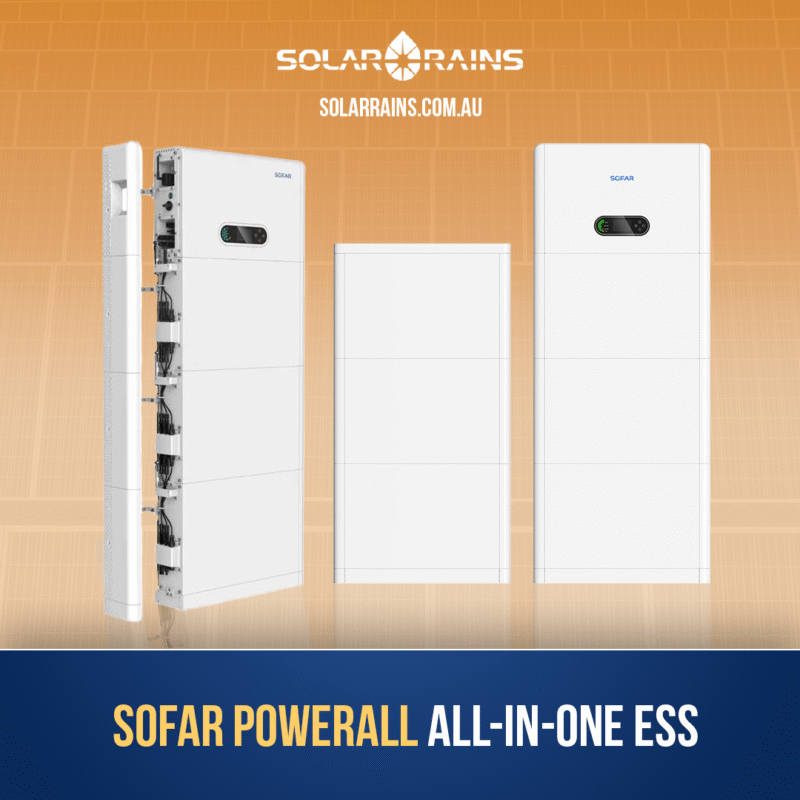
SOFAR PowerAll is a single-phase residential energy storage system combining a hybrid inverter and modular battery storage.
The current SOFAR PowerAll product page lists inverter sizes from 3kW to 6kW and battery configurations from 5kWh to 30kWh.
SOFAR also highlights:
- Stackable integrated design
- Dual MPPT
- Up to 16A PV input current
- Support for mixing compatible old and new batteries
- Integrated battery power-control architecture
- Modular maintenance
As a result, PowerAll suits homeowners who want a compact system that can be configured around different storage requirements.
Solar Rains currently supplies larger SOFAR PowerAll configurations for Australian residential projects.
View SOFAR PowerAll at Solar Rains
What Is AlphaESS SMILE5?

AlphaESS SMILE5 is a 5kW single-phase hybrid energy storage system designed for residential solar and battery applications.
The current AlphaESS Australia SMILE5 page lists two major battery pathways:
- 13.34kWh modules, supporting up to six batteries
- 15.07kWh modules, supporting up to five batteries
That gives current listed capacity ranges of approximately:
- 13.3–80kWh
- 15.07–75.36kWh
AlphaESS also lists:
- LFP battery chemistry
- IP65 protection
- UPS backup
- VPP-ready functionality
- AlphaCloud monitoring
- Hybrid inverter architecture
Therefore, the old claim that AlphaESS is a fixed, non-expandable 5kWh battery is no longer an accurate description of the current SMILE5 family. AlphaESS currently offers substantial expansion options.
Solar Rains also maintains a listing for an earlier 5kW inverter and 5kWh AlphaESS configuration.
View the AlphaESS system at Solar Rains
For a more detailed owner guide, see:
How to Improve Alpha ESS Battery Performance
SOFAR vs AlphaESS: Battery Capacity
Battery capacity is one of the biggest differences when comparing SOFAR vs AlphaESS.
SOFAR PowerAll Capacity
The current SOFAR PowerAll family supports:
5 / 10 / 15 / 20 / 25 / 30kWh
This makes the capacity progression relatively simple.
For example, a household can choose a smaller storage configuration or move toward larger 20–30kWh systems where evening consumption is higher.
AlphaESS SMILE5 Capacity
Current AlphaESS SMILE5 systems use larger battery-module options.
AlphaESS Australia currently lists:
- 13.34kWh per SMILE-BAT-13.3P
- 15.07kWh per SMILE-BAT-15P
Multiple modules can then be connected within the supported configuration.
Therefore, AlphaESS can now scale well beyond the smaller systems described in older comparisons.
Which Has Better Capacity Options?
Neither automatically wins.
SOFAR provides smaller capacity increments, which may make system sizing easier for households that do not require a very large battery.
In contrast, AlphaESS provides considerably larger overall capacity options in its current SMILE5 range.
The right choice depends on actual household consumption rather than the maximum capacity advertised by the manufacturer.
SOFAR vs AlphaESS: Expandability
Both systems are expandable.
That is an important correction to the previous version of this article.
SOFAR Expansion
SOFAR PowerAll uses a modular stacked design.
In addition, SOFAR states that compatible old and new batteries can be mixed within supported configurations, which may simplify future upgrades.
However, installers still need to check:
- Battery generation
- Firmware
- Inverter compatibility
- Approved configuration
- Manufacturer instructions
AlphaESS Expansion
Current AlphaESS SMILE5 systems also support multiple battery modules.
For example, the SMILE-BAT-13.3P supports one to six modules in parallel, while the SMILE-BAT-15P supports one to five. (AlphaESS SMILE5)
Therefore, it is inaccurate to choose SOFAR solely because “AlphaESS cannot be expanded”.
Both can scale. However, they do so using different battery architectures.
Backup Power Comparison
Backup performance matters when the grid fails.
SOFAR PowerAll
PowerAll supports off-grid or emergency power operation in compatible installations.
Solar Rains’ current PowerAll listing also specifies fast backup switching for supported configurations.
See SOFAR PowerAll specifications
AlphaESS SMILE5
AlphaESS markets the current SMILE5 as providing UPS backup.
The company also publishes Australian installations where SMILE5 supplies backup loads during outages. For example, AlphaESS documented a 5kW / 10.1kWh SMILE5 installation in Mount Dandenong on 3 March 2026. (alphaess.au)
However, backup capability should not be judged only by battery capacity.
Also consider:
- Inverter backup output
- Essential-load configuration
- Surge requirements
- Single-phase or three-phase supply
- Which circuits are connected to backup
- Available battery energy
Therefore, neither SOFAR vs AlphaESS should be declared the winner for every blackout application without looking at the complete system design.
Monitoring and Energy Management
Both manufacturers provide system monitoring, but the platforms differ.
SOFAR Monitoring
SOFAR systems support digital monitoring of solar, battery and system operation through the manufacturer’s monitoring ecosystem.
Depending on the exact hardware, communication options can include Wi-Fi and other network interfaces.
AlphaCloud
AlphaESS uses AlphaCloud, which allows users and installers to monitor:
- Solar generation
- Household consumption
- Battery state of charge
- Grid import and export
- Charging and discharging
- Historical performance
AlphaCloud can also support remote diagnostics and charging schedules.
This may be particularly valuable for homeowners who want a detailed view of how the battery behaves throughout the day.
Installation and Space
Both systems are designed to reduce the complexity of matching separate battery and inverter brands.
However, their physical layouts differ.
SOFAR
PowerAll uses a vertically stacked architecture.
Therefore, adding more battery modules generally increases the height of the installation.
This design can work well where wall width is limited but adequate vertical and installation clearance is available.
AlphaESS
SMILE5 uses a separate inverter and battery arrangement within the same manufacturer ecosystem.
Current 13.3kWh and 15kWh battery modules are relatively large individual units. Therefore, installers need to account for both physical size and weight when selecting the installation location.
In either case, battery placement must follow:
- Manufacturer clearances
- Applicable Australian standards
- Fire and access requirements
- Temperature requirements
- Electrical installation requirements
A battery should never be selected only because it appears smaller in a product photograph.
SOFAR vs AlphaESS for Existing Solar Systems
The existing solar system can influence the decision.
If you are replacing both the solar inverter and adding storage, either integrated platform may provide a straightforward pathway.
However, retrofit projects require more investigation.
Before changing systems, check:
- Existing inverter
- Solar array voltage and current
- Available switchboard capacity
- Single or three-phase supply
- Existing monitoring equipment
- Backup requirements
Therefore, ask an installer to assess the existing system before assuming that one battery will connect directly.
Which System Is Better for Different Homes?
Instead of declaring one universal winner in SOFAR vs AlphaESS, compare them by use case.
Consider SOFAR PowerAll If You Want:
- Smaller battery capacity increments
- A compact stackable architecture
- Up to 30kWh within the current PowerAll range
- A SOFAR inverter and battery ecosystem
- Flexible capacity selection
Consider AlphaESS SMILE5 If You Want:
- Larger battery configurations
- AlphaCloud monitoring
- A mature integrated residential ESS platform
- VPP-ready functionality
- Current expansion well beyond 30kWh
- AlphaESS UPS backup architecture
However, bigger capacity does not automatically mean better value.
A household consuming 8kWh after sunset may gain little from installing 40kWh of storage.
SOFAR vs AlphaESS and the 2026 Battery Rebate
Battery rebate eligibility should also be checked before purchasing either system.
Australia’s Cheaper Home Batteries Program changed on 1 May 2026.
The Australian Government currently supports eligible systems with:
- 5–100kWh nominal battery capacity
- STCs applied to the first 50kWh of usable capacity
- New and eligible existing-solar installations
- Stacked battery systems
Check the current Cheaper Home Batteries eligibility rules
However, brand name alone does not determine eligibility.
The exact battery and power-conversion equipment must meet current requirements.
The Clean Energy Council Approved Batteries List should therefore be checked for the exact configuration before installation.
The CEC also began transitioning battery approvals toward SA TS 5398 in 2026, which makes checking current listing status increasingly important.
What About Price?
This article focuses on system design and features rather than price because equipment pricing can change rapidly.
Solar Rains has a separate comparison covering the pricing and value differences between Deye, AlphaESS and SOFAR.
Compare Solar Battery Prices: Deye vs AlphaESS vs SOFAR
Keeping the two topics separate makes the comparison clearer:
- This article: SOFAR vs AlphaESS technology and system design
- Price article: cost and value comparison
You can also browse all available products here:
Explore Residential Batteries and Inverters
FAQs About SOFAR vs AlphaESS
Is AlphaESS battery storage expandable?
Yes.
Current AlphaESS SMILE5 systems support multiple battery modules. Depending on the battery model, current AlphaESS Australia specifications list capacity ranges up to approximately 75–80kWh.
Can SOFAR PowerAll reach 30kWh?
Yes.
SOFAR currently lists PowerAll configurations from 5kWh to 30kWh. (SOFAR PowerAll)
Does AlphaESS only come with a 5kWh battery?
No.
Older SMILE5 configurations included smaller battery modules, and Solar Rains still has a product page for a 5kWh configuration.
However, current AlphaESS Australia SMILE5 products also include 13.34kWh and 15.07kWh battery modules.
Which is better for a large household?
It depends on energy consumption.
Both brands offer substantial storage. Therefore, compare overnight usage, solar production, backup requirements and future EV or electrification plans rather than household size alone.
Are SOFAR and AlphaESS eligible for the battery rebate?
Potentially, but never assume eligibility based only on brand.
The exact battery, inverter/PCE and final system configuration must satisfy the current program and approved-product requirements.
Final Verdict
The SOFAR vs AlphaESS comparison is much closer than the older version of this article suggested.
SOFAR PowerAll offers a clean stackable platform with current configurations from 5kWh to 30kWh. Meanwhile, AlphaESS SMILE5 now offers larger battery modules and significantly greater expansion potential than older 5kWh systems.


