
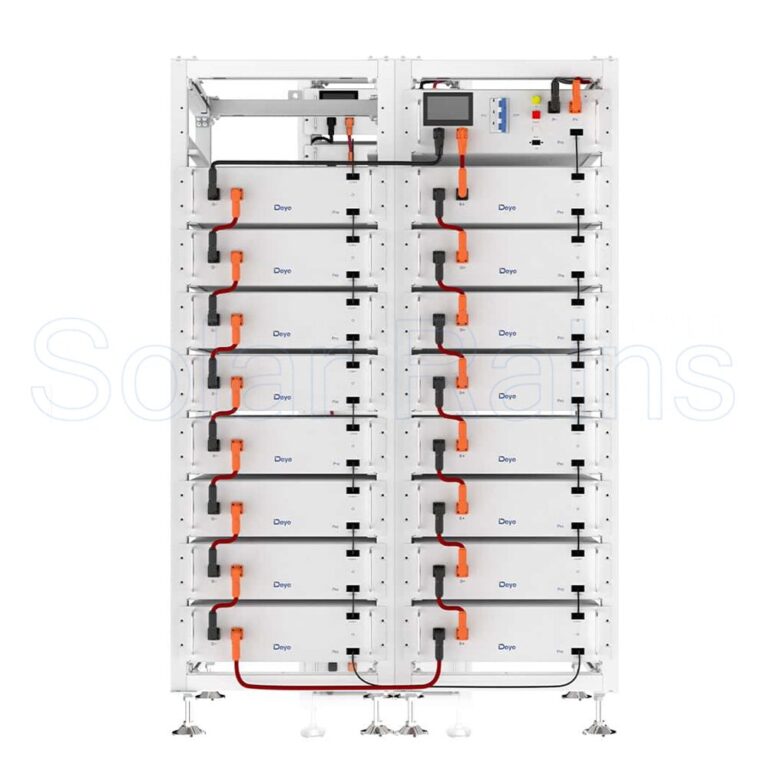
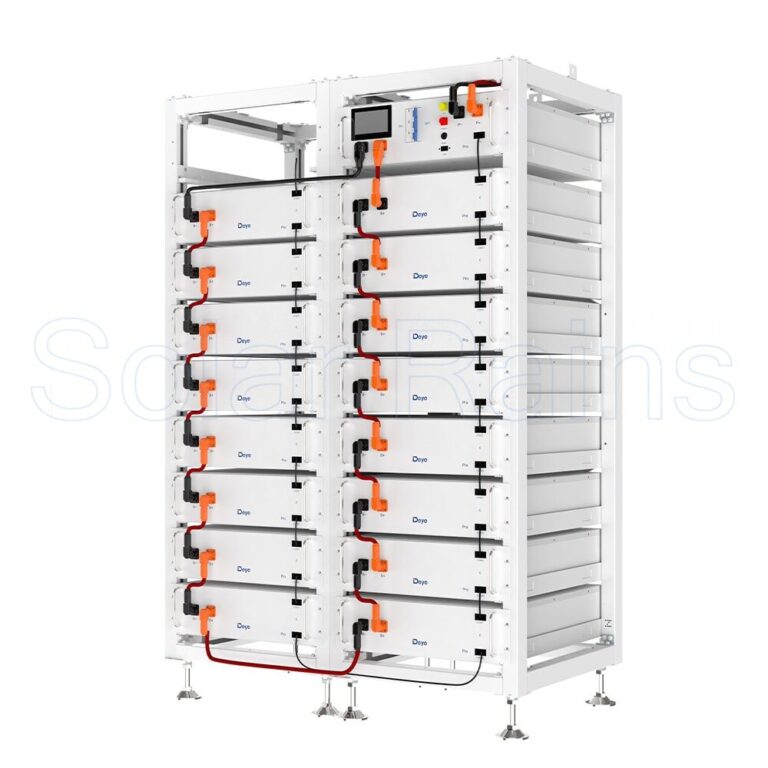
Deye Control Box for High Voltage C&I High Voltage Battery Cluster
$1,290.00
Add the product to your cart and request a quote at checkout
Description
The DEYE High Voltage C&I Battery Module BDU, supplied under the BOS-G Pro PDU2 classification, is identified in Deye’s product documentation as model BOS-G-PDU-2, a High Voltage Battery cluster control box conforming to European or British Standards. It is designed as part of the BOS-G Pro rack-mounted high-voltage battery system for small-scale commercial and industrial energy storage applications.
The Deye BOS-G Pro PDU operates across a 200–1000Vdc voltage range, with a nominal charge and discharge current of 100A and a maximum charge and discharge current of 120A. It has a 12±2%V / 4.15A DC input rating and an operating temperature range of -20°C to 65°C. The enclosure is rated IP20, while the control box measures 440 × 570 × 150mm and weighs approximately 19kg.
The control box forms part of the BOS-G Pro battery architecture together with BOS-G-Pack5.1 battery modules and optional rack systems. Each battery module uses LiFePO4 chemistry and provides 5.12kWh of rated energy, with a nominal voltage of 51.2Vdc and rated capacity of 100Ah. The BOS-G Pro system can be configured with different numbers of battery modules to provide different energy capacities.
For the supplied product classification, the control box is therefore the high-voltage control component of the battery cluster rather than the 5.12kWh battery module itself. Deye documentation consistently identifies the supplied BOS-G Pro PDU2 model as BOS-G-PDU-2.
Key Features of Product
- Model: BOS-G-PDU-2.
- High Voltage Battery cluster control box for the BOS-G Pro system.
- Conforms to European or British Standards according to the supplied Deye documentation.
- Operating voltage: 200–1000Vdc.
- Nominal charge/discharge current: 100A.
- Maximum charge/discharge current: 120A.
- DC input rating: 12±2%V / 4.15A.
- Operating temperature range: -20°C to 65°C.
- IP20 ingress protection rating.
- Dimensions: 440 × 570 × 150mm.
- Approximate weight: 19kg.
- Designed for use within a rack-mounted high-voltage battery configuration.
- Standard configuration includes a 120-ohm terminal resistance.
- Includes 250mm communication cable and 140mm power cable.
- Includes a 2.1m power cable.
- Includes EPCable2.0 and ENCable2.0 for connection to the external PCS.
- Includes 1000mm communication and power cables between two battery racks.
- Includes a 140mm ground wire.
- Works within the BOS-G Pro battery architecture using BOS-G-Pack5.1 battery modules.
The associated BOS-G-Pack5.1 battery module uses LiFePO4 (LFP) chemistry, with a 51.2Vdc nominal voltage, 100Ah rated capacity and 5.12kWh rated energy. Its nominal charge/discharge current is 100A, with a peak discharge current of 120A.
The BOS-G Pro system is designed around rack-mounted battery modules. The supplied Deye brochure lists system configurations including BOS-G25-Pro, BOS-G40-Pro, BOS-G60-Pro and BOS-G80-Pro, using between five and sixteen battery modules respectively.
Main Benefits
The Deye high voltage battery control box provides a defined interface between the BOS-G Pro battery cluster and the wider energy storage system. Its 200–1000Vdc operating range and 100A nominal current rating provide the specified electrical operating parameters for the BOS-G Pro architecture.
For C&I energy storage system configuration, the modular BOS-G Pro design allows battery capacity to be selected according to the required system configuration. The documentation lists five battery modules for the BOS-G25-Pro configuration, eight for BOS-G40-Pro, twelve for BOS-G60-Pro and sixteen for BOS-G80-Pro.
The rack-based format also supports structured installation. Deye specifies optional 19-inch racks for the battery system, allowing the control box and battery modules to be integrated into the same rack-based architecture. The 3U-HRACK can accommodate 12 battery modules and one high-voltage battery cluster control box, while the 3U-LRACK can accommodate eight battery modules and one control box.
The battery system also incorporates LiFePO4 chemistry. Deye specifies protection functions against over-discharge, over-charge, over-current and over-high or low temperature. The system can automatically manage charge and discharge states and balance the current and voltage of each cell.
The system’s operating temperature specification also provides flexibility for different operating conditions. The battery modules are specified for charging from 0°C to 55°C and discharging from -20°C to 55°C, while the BOS-G-PDU-2 control box itself has an operating temperature range of -20°C to 65°C.
For system communication, the BOS-G Pro battery system uses CAN2.0 / RS485. Deye also specifies USB upgrade and remote upgrade compatibility with Deye inverters.
Installation
The supplied Deye references describe the BOS-G Pro as a rack-mounted high-voltage battery system and state that the standard 19-inch embedded design supports quick installation and maintenance. However, the supplied brochure does not provide a complete step-by-step installation procedure. To avoid introducing unsupported information, the installation guidance below is limited to the installation details explicitly provided by Deye.
The BOS-G Pro system uses optional 19-inch rack structures. The 3U-HRACK is specified to accommodate up to 12 battery modules and one High Voltage Battery cluster control box. Its stated dimensions are 530 × 602 × 2219mm, with an approximate weight of 51kg.
The 3U-LRACK is specified to accommodate up to eight battery modules and one High Voltage Battery cluster control box. It measures 530 × 602 × 1629mm and has an approximate weight of 41kg. Both racks can be fitted with an optional door according to the supplied documentation.
For the BOS-G-PDU-2 itself, the stated dimensions are 440 × 570 × 150mm and the approximate weight is 19kg. Its standard configuration includes communication and power cables, a 120-ohm terminal resistance, EPCable2.0, ENCable2.0 and a ground wire. The EPCable2.0 is specified as a standard 2-metre power cable connected to the positive pole of the external PCS, while ENCable2.0 is specified for the negative pole.
The documentation also specifies communication and power cables between two battery racks. These components form part of the standard high-voltage box configuration and should be considered when assembling the BOS-G Pro battery architecture.
Because the supplied references do not include the full mounting sequence, wiring sequence, commissioning procedure or shutdown procedure for the BOS-G-PDU-2, those steps have intentionally not been added here.
Deye
Deye is the brand behind the BOS-G Pro energy storage solution. According to Deye’s Australian website, Ningbo Deye Inverter Technology Co., Ltd. was founded in 2007 and is a subsidiary of the Deye Group. The company states that its manufacturing plant covers more than 15,000m² and includes production and testing facilities.
Deye describes its business as providing integrated solar PV and energy storage solutions for residential, commercial and industrial applications. Its stated product portfolio includes PV inverters, hybrid inverters and microinverters, alongside energy storage products and solutions.
The company also states that, by the end of 2025, cumulative Deye inverter shipments exceeded 5 million units, including 2 million hybrid inverters. Deye identifies commercial and industrial energy storage among its energy solutions and has developed battery product lines designed for use with Deye inverters.
The BOS-G-PDU-2 is identified by Deye as a High Voltage Battery cluster control box conforming to European or British Standards. It is a component of the BOS-G Pro rack-mounted high-voltage battery system.
The BOS-G-PDU-2 has a specified operating voltage range of 200–1000Vdc. Its nominal charge and discharge current is 100A, while the maximum charge and discharge current is 120A.
The associated battery module is the BOS-G-Pack5.1. It uses LiFePO4 (LFP) chemistry and has a nominal voltage of 51.2Vdc, rated capacity of 100Ah and rated energy of 5.12kWh.
Deye lists configurations from BOS-G25-Pro through BOS-G80-Pro. The BOS-G25-Pro uses five battery modules, while BOS-G40-Pro, BOS-G60-Pro and BOS-G80-Pro use eight, twelve and sixteen modules respectively.
Deye specifies two optional 19-inch rack configurations. The 3U-HRACK can accommodate 12 battery modules and one high-voltage battery cluster control box, while the 3U-LRACK can accommodate eight battery modules and one control box.
The BOS-G Pro battery system includes protection functions for over-discharge, over-charge, over-current and over-high or low temperature. It uses CAN2.0 / RS485 communication, and Deye specifies USB upgrade and remote upgrade compatibility with Deye inverters.
| Dimensions and Weights | |
|---|---|
| Weight | 19 kg |
| Dimensions | 57 x 44 x 15 cm |
| Download Area | |
|---|---|
Deye BOS-G Pro Series Brochure AU 1.0 | Download |
Deye NSW Peak Demand Reduction Scheme PDRS Solutions | Download |
| Specification | BOS-G-PDU-2 |
|---|---|
| Description | High Voltage Battery cluster control box conforming to European or British Standards |
| Operating Voltage | 200 ~ 1000Vdc |
| Nominal Charge/Discharge Current | 100A |
| Max. Charge/Discharge Current | 120A |
| Specification | BOS-G-PDU-2 |
|---|---|
| Description | High Voltage Battery cluster control box conforming to European or British Standards |
| Operating Voltage | 200 ~ 1000Vdc |
| Nominal Charge/Discharge Current | 100A |
| Max. Charge/Discharge Current | 120A |
| DC Input Rating | 12±2%V / 4.15A |
| Operating Temperature Range | -20 ~ 65°C |
| Ingress Protection | IP20 |
| Dimension (W×D×H) | 440 × 570 × 150 mm |
| Weight Approximate | 19 kg |


Reviews
There are no reviews yet.