
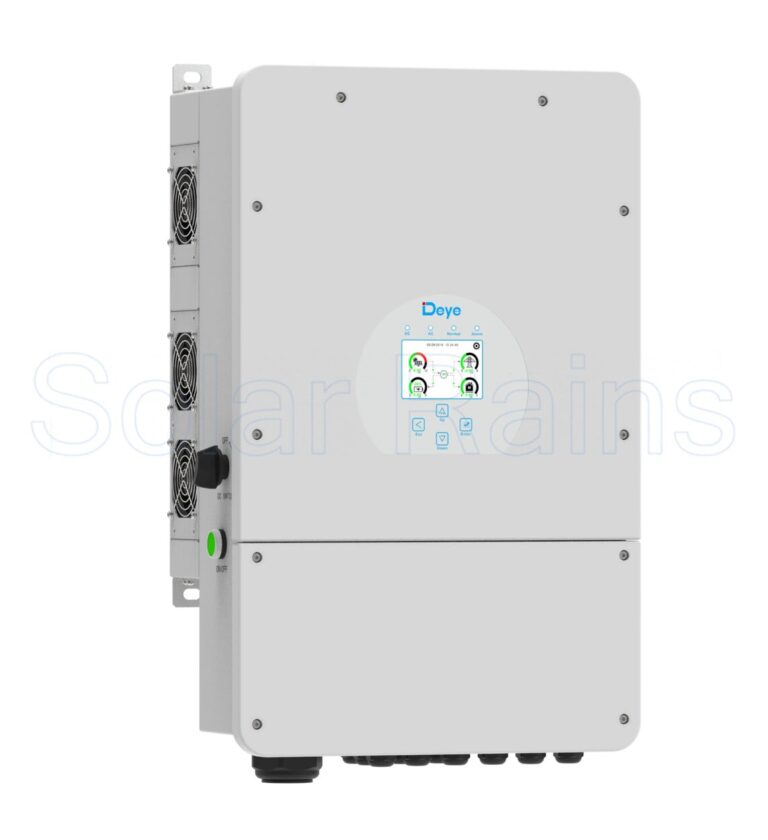
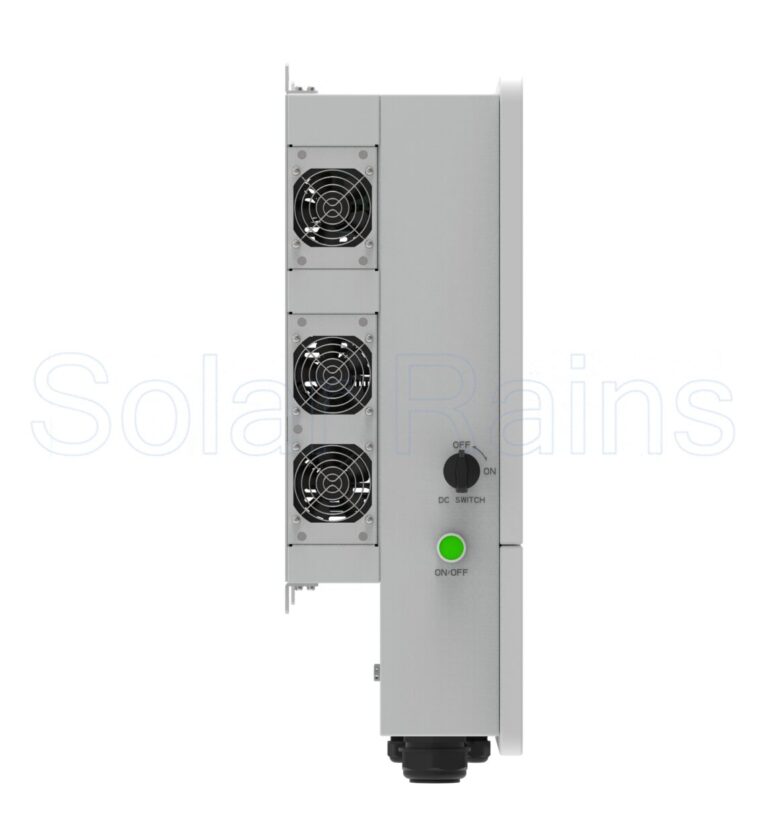
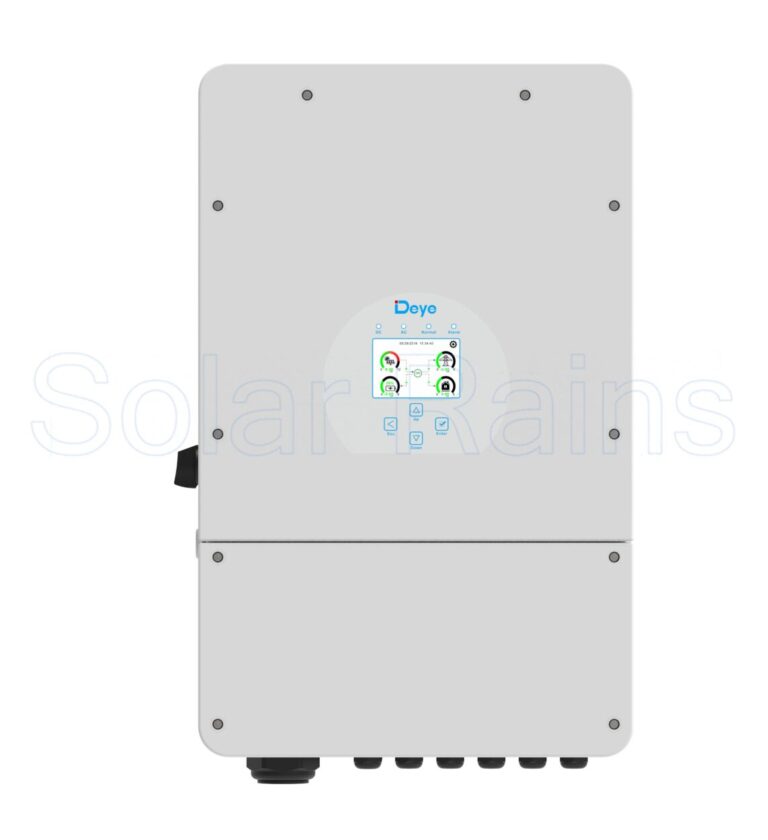
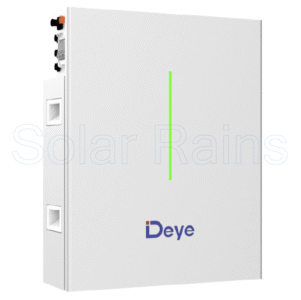
Deye Hybrid Inverter Single Phase 10kW or 12kW
Price range: $2,116.00 through $2,292.00
Add the product to your cart and request a quote at checkout
Description
The Deye single phase hybrid inverter range includes the SUN-10K-SG02LP1-AU-AM3 and SUN-12K-SG02LP1-AU-AM3, designed to combine solar PV, low-voltage battery storage, grid power and generator input within one flexible energy platform.
Both models operate with lead-acid or lithium-ion batteries across a 40–60V battery voltage range, with automatic BMS adaptation for lithium battery systems. The 10kW model supports up to 220A charging and discharging current, while the 12kW version increases this to 250A, providing substantial battery power capability for higher-demand residential energy systems.
PV design is equally flexible. Both models use three MPPT trackers, with two strings available per tracker. Maximum PV access power reaches 20kW for the 10kW model and 24kW for the 12kW model, while maximum PV input power is 15kW and 18kW respectively. Deye also supports AC coupling, allowing the inverter to be used when adding battery storage to an existing solar installation.
With programmable energy management, diesel generator support, parallel operation and backup capability, this inverter family is designed for homes requiring more control over how solar, battery and grid energy are used.
Key Features of DEYE Low Voltage Hybrid Inverter Single Phase 10kW, 12kW
- 10kW & 12kW Single-Phase Options: Rated AC active power is 9,999W for the 10kW model and 12,000W for the 12kW model.
- Low-Voltage Battery Support: Compatible with lead-acid or lithium-ion batteries operating between 40V and 60V.
- High Battery Current: Up to 220A charging/discharging for the 10kW version and 250A for the 12kW version.
- Automatic Lithium BMS Adaptation: Charging strategy can communicate with and adapt to a compatible lithium battery BMS.
- Three MPPT Trackers: Three independent MPPTs with a 2+2+2 string arrangement provide flexibility when designing PV arrays across different roof orientations.
- High PV Input Capacity: Maximum PV input power of 15kW for SUN-10K and 18kW for SUN-12K, with up to 20kW and 24kW PV access power respectively.
- AC Coupling: Supports retrofitting battery functionality into an existing solar system.
- Parallel Operation: Up to 16 inverters can operate in parallel for on-grid or off-grid configurations.
- Generator Energy Support: The system can store energy supplied by a diesel generator.
- Six Time-of-Use Periods: Battery charging and discharging can be scheduled across six programmable periods.
- Strong Off-Grid Capability: Peak off-grid output can reach twice rated power for 10 seconds.
- High Conversion Efficiency: Maximum efficiency is 97.6%, Euro efficiency is 96.5%, and MPPT efficiency is greater than 99%.
- IP65 Enclosure: Designed for outdoor-capable installation when Deye’s siting requirements are followed.
- Low Operating Noise: Specified at less than 45dB.
- Smart Monitoring & Communication: LCD interface with Wi-Fi, RS485 and CAN communication options.
- 10-Year Warranty: Deye specifies a 10-year warranty for this inverter family.
Main Benefits
For Homeowners
The Deye hybrid inverter allows solar, battery, grid and generator energy to be managed within one system. Instead of relying only on solar production during daylight hours, compatible battery storage can store energy for later use.
Deye’s programmable supply priorities and time-of-use settings allow the system to decide when battery energy or grid energy should be prioritised. The inverter also supports on-grid, off-grid and UPS operating modes, providing greater flexibility for households where backup operation is part of the system design.
For homes with existing solar, AC coupling provides another practical advantage: battery storage can be incorporated without necessarily redesigning the entire existing PV system.
For Solar Designers & Engineers
The three-MPPT architecture gives designers greater freedom when working with roofs that have different orientations or PV string layouts.
The Deye 10kW hybrid inverter supports up to 20kW PV access power, while the 12kW model increases this to 24kW. Both operate across a 150–425V MPPT range, with 500V maximum PV input voltage and 125V startup voltage.
The low-voltage 40–60V battery architecture, configurable battery charge parameters and CAN/RS485 communication also provide clear parameters for designing solar-plus-storage systems around compatible batteries.
For Installers & EPC Contractors
Several features are designed to reduce system complexity during installation and commissioning. The inverter combines PV, battery, grid, generator and load connections within the same architecture and provides a colour LCD interface for configuration.
Installers can also use programmable charging priorities, Smart Load functionality, zero-export control and Wi-Fi monitoring as part of the system configuration. The IP65 enclosure provides installation flexibility, while the product’s 420 × 670 × 233mm cabinet measures the same across both models and weighs approximately 35.6kg.
For Higher-Demand Residential Systems
The major distinction between the two versions is power capacity.
The Deye 12kW hybrid inverter provides 12kW rated AC output, 18kW maximum PV input and up to 250A battery charging/discharging. The 10kW version provides 9,999W rated output, 15kW maximum PV input and up to 220A battery current.
This gives system designers a clear choice based on household load, PV capacity and required battery power without changing to a different inverter platform.
Installation
Installation must be performed by qualified personnel. Deye specifies that the inverter must be connected to a permanently grounded wiring system and installed in accordance with applicable local requirements. All AC and DC sources must be properly isolated before electrical work or maintenance begins.
1. Choose the Installation Location
Select a vertical wall with sufficient load-bearing capacity. Deye recommends concrete or another non-flammable mounting surface.
Although the inverter carries an IP65 rating, Deye instructs installers to avoid direct sunlight, rain exposure and snow accumulation. The installation location should also be away from flammable materials, potentially explosive areas and excessive humidity.
Installation altitude should not exceed approximately 2,000m. The specified operating temperature range is -40°C to +60°C, with output derating above 45°C.
2. Maintain Installation Clearances
Adequate ventilation is important because both models use intelligent air cooling.
Deye specifies approximately:
- 500mm clearance on each side
- 500mm above and below
- 1,000mm clearance in front
The LCD should ideally remain at eye level so that operating information can be checked easily during commissioning and maintenance.
3. Mount the Inverter
Position the inverter at the planned mounting location and ensure it is level.
For Deye’s default mounting method:
- Mark the four fixing positions on the wall.
- Drill four holes approximately 82–90mm deep.
- Insert the expansion bolts.
- Lift the inverter into position.
- Align the mounting points with the expansion bolts and secure the inverter firmly.
An optional wall bracket method is also documented. The bracket is fixed first, after which the inverter is lifted above it and lowered into its secured position.
Because the inverter weighs approximately 35.6kg, Deye recommends suitable personnel or handling equipment and instructs installers to lift the unit using its handles rather than its electrical terminals.
4. Connect the Battery
A separate DC over-current protection or disconnect arrangement is required between the battery and inverter as specified in Deye’s manual.
For both the 10kW and 12kW models, Deye recommends:
- 1 AWG / 35mm² battery cable
- M10 battery connector
- Maximum tightening torque of 24.5Nm
Battery polarity must be checked carefully before energising the system. The positive and negative terminals at both the inverter and battery must correspond correctly.
5. Complete PV, Grid & Load Connections
Connect the PV strings, grid supply, backup load and communication wiring according to the diagrams and conductor requirements in the Deye manual.
The system includes dedicated connections for PV, grid, load, generator, BMS, meter, CT, parallel communication and Wi-Fi monitoring.
Before PV connection, verify array polarity and confirm that PV voltage remains within the inverter’s specified operating limits.
6. Commission & Configure
After all mechanical fixings, grounding and electrical connections have been inspected, the inverter can be powered on and configured through its LCD interface.
Installers can configure battery parameters, AC/solar/generator charging priority, time-of-use periods, operating mode and Smart Load functions. Deye supports on-grid, off-grid and UPS configurations, allowing the final setup to be matched to the intended system architecture.
Deye
Ningbo Deye Inverter Technology Co., Ltd. was founded in 2007 and develops integrated solar PV and energy storage solutions for residential, commercial and industrial applications.
Its portfolio includes string inverters, hybrid inverters, microinverters and energy storage products. Deye states that cumulative inverter shipments exceeded five million units by the end of 2025, including approximately two million hybrid inverters.
The company began developing its first-generation hybrid inverter in 2017 and continues to build products around integrated PV, battery storage and intelligent energy management.
The SUN-10K-SG02LP1-AU-AM3 provides 9,999W rated AC power, 15kW maximum PV input and up to 220A battery charging/discharging. The SUN-12K-SG02LP1-AU-AM3 increases these values to 12kW AC output, 18kW PV input and 250A battery current.
Both models support lead-acid or lithium-ion batteries across a 40–60V voltage range. For lithium batteries, the charging strategy supports automatic adaptation to the compatible BMS.
Yes. Deye specifically lists AC coupling for retrofitting existing solar systems as a supported feature. This allows compatible battery storage and hybrid energy management to be incorporated into an existing PV installation.
Yes. The inverter supports on-grid, off-grid and UPS modes. For off-grid operation, Deye specifies peak output of up to twice the rated power for 10 seconds, helping accommodate temporary load surges.
Yes. Generator support is built into the system architecture, and Deye specifically states that energy from a diesel generator can be stored. Charging priority between AC, solar and generator sources can also be configured through the inverter settings.
The inverter enclosure is IP65 rated, but correct siting is still required. Deye instructs installers to avoid direct sunlight, direct rain exposure, snow accumulation, highly flammable environments and excessive humidity. Following these installation requirements helps maintain cooling and reliable long-term operation.
| Dimensions and Weights | |
|---|---|
| SKU | SUN-10K-SG02LP1-AU-AM3 |
| Weight | 35.6 kg |
| Dimensions | 23.3 x 42 x 67 cm |
| Dimensions and Weights | |
|---|---|
| SKU | SUN-12K-SG02LP1-AU-AM3 |
| Weight | 35.6 kg |
| Dimensions | 23.3 x 42 x 67 cm |
| Download Area | |
|---|---|
DEYE Low Voltage Hybrid Inverter Single Phase 10kW, 12kW - Datasheet | Download |
DEYE Low Voltage Hybrid Inverter Single Phase 10kW, 12kW - Manual | Download |
| Category | Parameter | Value |
| Battery Input Data | Battery Type | Lead-acid or Lithium-ion |
| Battery Voltage Range (V) | 40–60 | |
| Max. Charging Current (A) | 220 | |
| Max. Discharging Current (A) | 220 | |
| Charging Strategy for Li-Ion Battery | Self-adaption to BMS | |
| Number of Battery Input | 1 | |
| PV String Input Data | Max. PV access power (W) | 20000 |
| Max. PV Input Power (W) | 15000 | |
| Max. PV Input Voltage (V) | 500 | |
| Start-up Voltage (V) | 125 | |
| MPPT Voltage Range (V) | 150–425 | |
| Rated PV Input Voltage (V) | 370 | |
| Max. Operating PV Input Current (A) | 26+26+26 | |
| Max. Input Short-Circuit Current (A) | 44+44+44 | |
| No. of MPP Trackers / No. of Strings MPP Tracker | 3/2+2+2 | |
| AC Input/Output Data | Rated AC Input/Output Active Power (W) | 9999 |
| Max. AC Input/Output Apparent Power (VA) | 9999 | |
| Rated AC Input/Output Current (A) | 43.5 | |
| Max. AC Input/Output Current (A) | 43.5 | |
| Max. Continuous AC Passthrough (grid to load) (A) | 60 | |
| Peak Power (off grid) | 2 time of rated power, 10S | |
| Power Factor Adjustment Range | 0.8 leading to 0.8 lagging | |
| Rated Input/Output Voltage/Range (V) | 230 / 240, 0.8Un–1.1Un | |
| Rated Input/Output Grid Frequency/Range | 50Hz / 45Hz–55Hz | |
| Grid Connection Form | L+N+PE | |
| Total Current Harmonic Distortion THDi | <3% (of nominal power) | |
| DC Current Injection | <0.5% In | |
| Efficiency | Max. Efficiency | 97.60% |
| Euro Efficiency | 96.50% | |
| MPPT Efficiency | >99% | |
| Protection | Integrated | DC Reverse Polarity Protection, AC Output Overcurrent Protection, Thermal Protection, AC Output Overvoltage Protection, AC Output Short Circuit Protection, DC Component Monitoring, Insulation Impedance Detection, Arc Fault Circuit Interrupter (optional), DC Switch, Anti-Islanding Protection (Active Frequency shift), Residual Current Detection |
| Surge Protection Level | TYPE II (DC), TYPE II (AC) | |
| Interface | Communication Interface | RS485/CAN |
| LCD/LED Display | LCD | |
| General Data | Operating Temperature Range (°C) | -40 to +60°C, >45°C Derating |
| Permissible Ambient Humidity | 0–100% | |
| Permissible Altitude | 2000m | |
| Noise (dB) | <45 dB | |
| Inverter Topology | Non-Isolated | |
| Over Voltage Category | OVC II (DC), OVC III (AC) | |
| Weight (kg) | 35.6 | |
| Cabinet size (mm) | 420W × 670H × 233D (Excluding connectors and brackets) | |
| Protection Degree | IP65 | |
| Protection Level | Class I | |
| Type of Cooling | Intelligent Air Cooling | |
| Warranty | 10 Year | |
| Grid Regulation | AS/NZS 4777.2 | |
| Safety / EMC Standard | IEC/EN 61000-6-1/2/3/4, IEC/EN 62109-1, IEC/EN 62109-2 |
| Category | Parameter | Value |
| Battery Input Data | Battery Type | Lead-acid or Lithium-ion |
| Battery Voltage Range (V) | 40–60 | |
| Max. Charging Current (A) | 220 | |
| Max. Discharging Current (A) | 220 | |
| Charging Strategy for Li-Ion Battery | Self-adaption to BMS |
| Category | Parameter | Value |
| Battery Input Data | Battery Type | Lead-acid or Lithium-ion |
| Battery Voltage Range (V) | 40–60 | |
| Max. Charging Current (A) | 250 | |
| Max. Discharging Current (A) | 250 | |
| Charging Strategy for Li-Ion Battery | Self-adaption to BMS | |
| Number of Battery Input | 1 | |
| PV String Input Data | Max. PV access power (W) | 24000 |
| Max. PV Input Power (W) | 18000 | |
| Max. PV Input Voltage (V) | 500 | |
| Start-up Voltage (V) | 125 | |
| MPPT Voltage Range (V) | 150–425 | |
| Rated PV Input Voltage (V) | 370 | |
| Max. Operating PV Input Current (A) | 26+26+26 | |
| Max. Input Short-Circuit Current (A) | 44+44+44 | |
| No. of MPP Trackers / No. of Strings MPP Tracker | 3/2+2+2 | |
| AC Input/Output Data | Rated AC Input/Output Active Power (W) | 12000 |
| Max. AC Input/Output Apparent Power (VA) | 12000 | |
| Rated AC Input/Output Current (A) | 52.2 | |
| Max. AC Input/Output Current (A) | 52.2 | |
| Max. Continuous AC Passthrough (grid to load) (A) | 60 | |
| Peak Power (off grid) | 2 time of rated power, 10S | |
| Power Factor Adjustment Range | 0.8 leading to 0.8 lagging | |
| Rated Input/Output Voltage/Range (V) | 230 / 240, 0.8Un–1.1Un | |
| Rated Input/Output Grid Frequency/Range | 50Hz / 45Hz–55Hz | |
| Grid Connection Form | L+N+PE | |
| Total Current Harmonic Distortion THDi | <3% (of nominal power) | |
| DC Current Injection | <0.5% In | |
| Efficiency | Max. Efficiency | 97.60% |
| Euro Efficiency | 96.50% | |
| MPPT Efficiency | >99% | |
| Protection | Integrated | DC Reverse Polarity Protection, AC Output Overcurrent Protection, Thermal Protection, AC Output Overvoltage Protection, AC Output Short Circuit Protection, DC Component Monitoring, Insulation Impedance Detection, Arc Fault Circuit Interrupter (optional), DC Switch, Anti-Islanding Protection (Active Frequency shift), Residual Current Detection |
| Surge Protection Level | TYPE II (DC), TYPE II (AC) | |
| Interface | Communication Interface | RS485/CAN |
| LCD/LED Display | LCD | |
| General Data | Operating Temperature Range (°C) | -40 to +60°C, >45°C Derating |
| Permissible Ambient Humidity | 0–100% | |
| Permissible Altitude | 2000m | |
| Noise (dB) | <45 dB | |
| Inverter Topology | Non-Isolated | |
| Over Voltage Category | OVC II (DC), OVC III (AC) | |
| Weight (kg) | 35.6 | |
| Cabinet size (mm) | 420W × 670H × 233D (Excluding connectors and brackets) | |
| Protection Degree | IP65 | |
| Protection Level | Class I | |
| Type of Cooling | Intelligent Air Cooling | |
| Warranty | 10 Year | |
| Grid Regulation | AS/NZS 4777.2 | |
| Safety / EMC Standard | IEC/EN 61000-6-1/2/3/4, IEC/EN 62109-1, IEC/EN 62109-2 |
| Category | Parameter | Value |
| Battery Input Data | Battery Type | Lead-acid or Lithium-ion |
| Battery Voltage Range (V) | 40–60 | |
| Max. Charging Current (A) | 250 | |
| Max. Discharging Current (A) | 250 | |
| Charging Strategy for Li-Ion Battery | Self-adaption to BMS |


Reviews
There are no reviews yet.